




RUDN researchers have prepared for publication a special issue ‘THE FUTURE OF MATHEMATICAL COSMOLOGY’ of the world’s oldest scientific journal Philosophical Transactions of the Royal Society (Proceedings of the British Academy of Sciences)
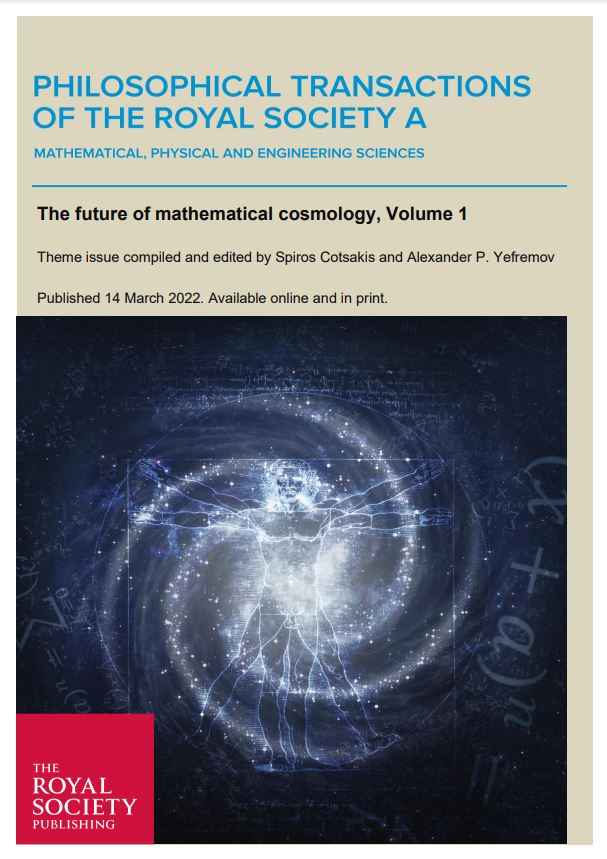
This world’s oldest scientific journal has been published without interruption for more than 350 years — since 1665.; great physicists and mathematicians Newton, Boyle, Huygens, Leibniz published their works in it. Currently, an article can be published in this journal only at the invitation of the Academy.
The thematic issue is published in two volumes and contains more than 20 articles.
As authors, the editors of the issue invited and received the consent of the world’s leading scientists and specialists in the field of theoretical and mathematical physics, among them Robert Brandenberger (Canada), Susan Scott (Australia), James Eisenberg (USA), Kirill Bronnikov (Russia) and many others.
The preface to the issue, as well as the fundamental review article “100 years of Mathematical Cosmology: models, theories and problems” were written by S. Kotsakis and A.P. Yefremov.
In general, the issue contains six scientific publications of RUDN scientists.
A brief introduction to the thematic issue says:
What are the main achievements in theoretical cosmology in the past 100 years? What is its present status and future prospects? What do we know about the big bang, dark energy, the future of the universe, the shape of spacetime, the multiverse, and the quantum nature of the cosmos?
Mathematical cosmology was born in 1917 when Einstein showed us how to build entire universes consistent with the laws of physics. Since then, it has developed into a fascinating field providing explanations for the new data and observations.
This theme issue is the first devoted solely to the intricate nature of the universes and the deep research uncovering the mysteries of this most majestic science, our home.
In 2021, RUDN launched a grant support system for young scientists and research teams. To date, 247 teams from various institutes and faculties, including those outside our university, have participated in the program.
A young scientist at RUDN University is not just a researcher, but a bridge between cultures and disciplines. Their strength lies in “hybrid” thinking: they combine the traditions of the Russian academic school with a global perspective, work in international collaborations, and see science as a tool for solving specific problems facing humanity — from food security to interfaith dialogue. Their research is born at the intersection of faculties, and the results speak for themselves in Q1 and Q2 articles and real technologies.
Sergey Ivanov, a scientist from St. Petersburg, became the first winner of the RUDN University International Prize for scientific achievements and merits in the field of mathematics in the amount of 5 million rubles.
In 2021, RUDN launched a grant support system for young scientists and research teams. To date, 247 teams from various institutes and faculties, including those outside our university, have participated in the program.
A young scientist at RUDN University is not just a researcher, but a bridge between cultures and disciplines. Their strength lies in “hybrid” thinking: they combine the traditions of the Russian academic school with a global perspective, work in international collaborations, and see science as a tool for solving specific problems facing humanity — from food security to interfaith dialogue. Their research is born at the intersection of faculties, and the results speak for themselves in Q1 and Q2 articles and real technologies.
Sergey Ivanov, a scientist from St. Petersburg, became the first winner of the RUDN University International Prize for scientific achievements and merits in the field of mathematics in the amount of 5 million rubles.