




RUDN engineers: vegetable oil destroys concrete
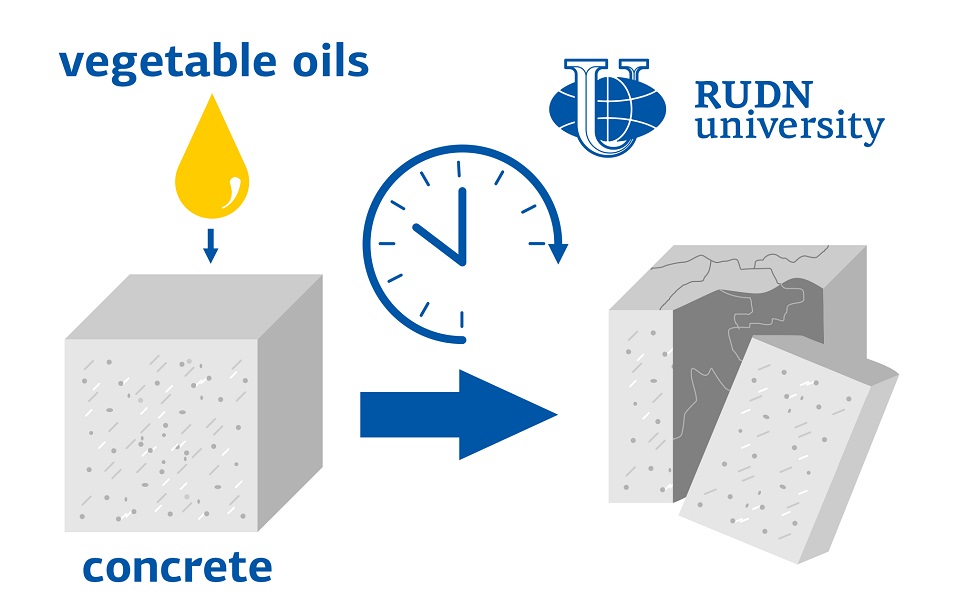
Factories in various industries use vegetable oils. These can be both edible oils and technical ones, which are used, for example, for lubricating parts. Oils are often spilled on the concrete floor. When they come into contact with the main component of cement — calcium oxide — fatty acids are obtained. RUDN University engineers found out that fatty acids and oils can destroy concrete. Due to fatty acids, micro cracks appear in concrete. It then leads to large fractures — and so the material is destroyed.
“Edible and technical vegetable oils are used in many industries. They constantly fall on concrete and reinforced concrete structures and impregnate them. Oils contain high molecular weight fatty acids that destroy cement stone and concrete. Under the action of calcium oxide on fats and oils, alcohols and fatty acids are formed. We studied the aggressive effect of these acids from fatty vegetable oils on the strength of cement-sand mortar and concrete,” Alexander Svintsov, Doctor of Engineering, Professor at the Department of Construction of RUDN University.
Engineers studied the effect of oil on concrete and cement stone. They differ in the proportions of the components (water, sand, cement). In addition, there is a granite crumb in the concrete. RUDN engineers immersed samples of both materials in corn, olive or palm oil and left them at room temperature (from 16℃ to 24℃). Every ten days, the researchers took out the samples and studied their compressive strength.
After being immersed in oil, the materials became more brittle. After 60 days, the strength decreased by an average of 61.2%, and after 90 days, the samples began to spontaneously collapse. The engineers also built a mathematical model that predicts how much the strength of concrete will change after 70 days of exposure to oil.
“Our results are important for predicting changes in concrete structures under the influence of vegetable oil and for ensuring their comprehensive protection. An empirical mathematical model of strength at different durations of oil action is a new way to improve the operating conditions of industrial buildings in which vegetable oil is used in technological processes. This is important for the design, construction and operation of industrial buildings,” Alexander Svintsov, Doctor of Engineering, Professor at the RUDN University Construction Department.
Results published in Construction magazine and building materials.
In the last five years, academic staff of RUDN alongside the Chinese universities and research centers has achieved impressive results. More than 1,000 scientific publications were made jointly in a wide spectrum from engineering and technology to medicine and social sciences. 19 of these materials were published in top-rated journals which verifies that the works were world-class level.
RUDN University has been included among the leaders in the BRICS ESG University Ranking among 65 leading universities. They were assessed on 20 criteria, ranging from education and research to environmental and social agendas.
At a meeting of the new RUDN University Dissertation Council in the specialties of 2.1.12 “Architecture of Buildings and Structures. Creative Concepts of Architectural Activity” and 2.1.11 “Theory and History of Architecture, Restoration and Reconstruction of Historical and Architectural Heritage”, three postgraduate students — Natalia Kalinina, Evgeny Ogienko, and Yulia Loginova — were awarded PhD degrees in Architecture for the first time in the university's history.