




RUDN University medics detect alterations in amino acid profiles in children with ADHD
Attention deficit hyperactivity disorder (ADHD) is a neurodevelopmental disorder that manifests itself in childhood. Children with ADHD find it difficult to concentrate and manage their impulsivity. It is known that ADHD is also manifested at the neurochemical level — for example, the work of dopamine and norepinephrine is disrupted. However, there is still no definitive data on how the responsible for brain function amino acids profile changes in ADHD. Although drugs consisting of amino acids are often used for the treatment of ADHD. Scientists of the RUDN University detected the alterations of the amino acid profile in blood serum in children with ADHD.
“Amino acids serve a significant role in brain development and functioning. In particular, certain amino acids or their precursors are well-established to be involved in neuronal signaling as neurotransmitters. Correspondingly, disruption of amino acid metabolism results in significant neurological disorders, particularly in children. Therefore, unraveling the potential underlying mechanisms implicated in ADHD pathogenesis is essential for improving our understanding of the disorder and further development of management strategies”, Anatoly Skalny, DSc, Head of RUDN Department of medical elements studies
102 children aged 7 to 14 years were involved in the study. 71 of them were diagnosed with ADHD, the rest of the participants were neurotypical (without diagnosed disorders). The level of amino acids in the blood serum was measured using liquid chromatography. Then scientists compared the data obtained in children with ADHD and neurotypical children using statistical methods.
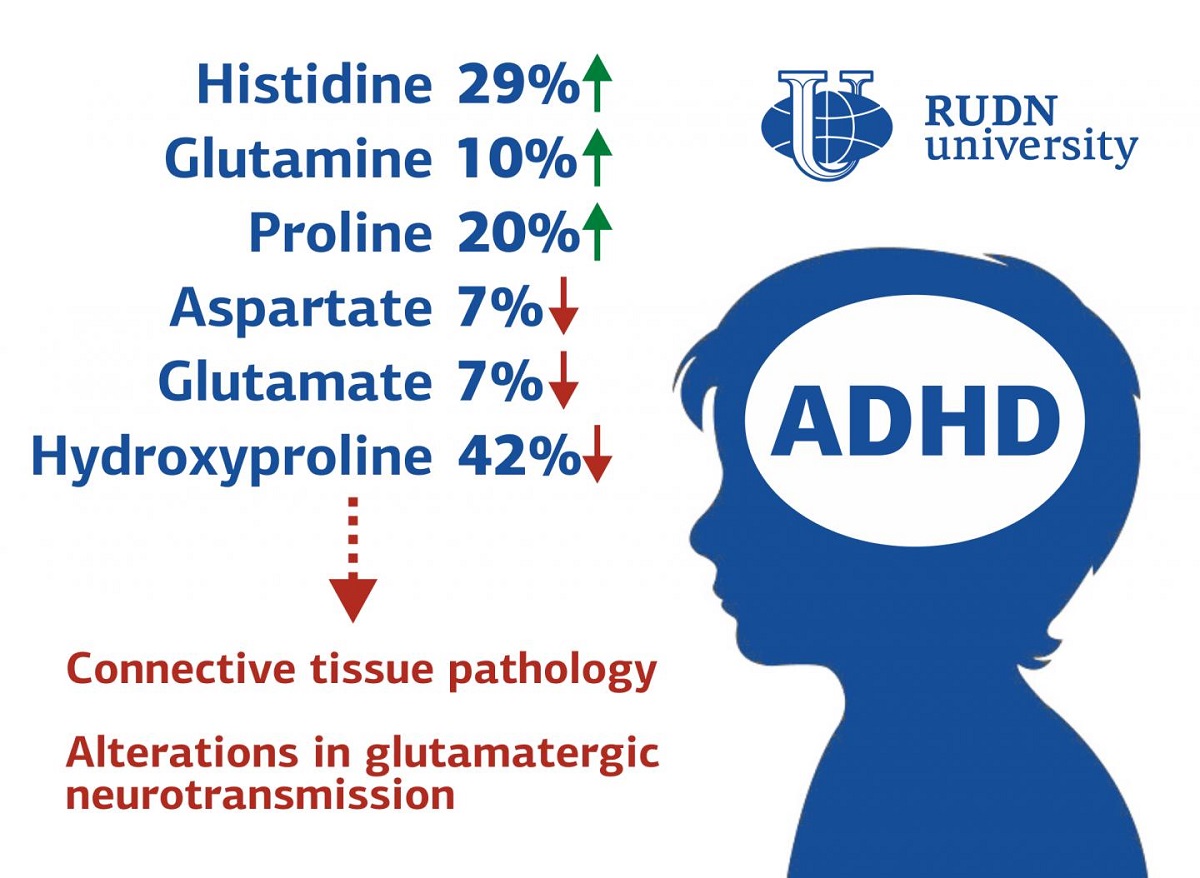
It turned out that the serum amino acid profile in children with ADHD differs from neurotypical children. Histidine, glutamine, and proline levels were found to be 29%, 10%, and 20% lower, respectively. Aspartic acid and glutamate were found to be 7% higher, and hydroxyproline-42% higher. Accordingly, the ratio of glutamine to glutamate in children with ADHD is 28% lower than normal, and the ratio of proline to hydroxyproline is 29% lower. The first ratio is one of the indicators of the transmission of nerve impulses, and the second can be a marker of disorders of collagen metabolism and connective tissue. Related diseases are sometimes considered to be associated with ADHD.
“The observed alterations in Pro/Hypro and Gln/Glu levels and ratios are likely associated with the coexisting connective tissue pathology and alterations in glutamatergic neurotransmission in ADHD, respectively. However, further in vivo and in vitro studies are required in order to investigate the detailed mechanisms linking amino acid metabolism with ADHD”, Anatoly Skalny, DSc, Head of RUDN Department of medical elements studies.
The study is published in the journal Biomedical Reports.
In the last five years, academic staff of RUDN alongside the Chinese universities and research centers has achieved impressive results. More than 1,000 scientific publications were made jointly in a wide spectrum from engineering and technology to medicine and social sciences. 19 of these materials were published in top-rated journals which verifies that the works were world-class level.
RUDN University has been included among the leaders in the BRICS ESG University Ranking among 65 leading universities. They were assessed on 20 criteria, ranging from education and research to environmental and social agendas.
At a meeting of the new RUDN University Dissertation Council in the specialties of 2.1.12 “Architecture of Buildings and Structures. Creative Concepts of Architectural Activity” and 2.1.11 “Theory and History of Architecture, Restoration and Reconstruction of Historical and Architectural Heritage”, three postgraduate students — Natalia Kalinina, Evgeny Ogienko, and Yulia Loginova — were awarded PhD degrees in Architecture for the first time in the university's history.