




Professor Wolf Ferdinand Wieland told about the directions of possible cooperation between universities in Moscow and Bavaria
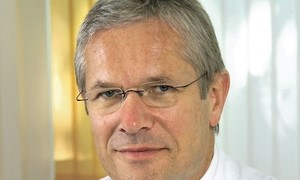
September 20, 2017 Professor of the University of Regensburg Wolf Ferdinand Wieland has made a public lecture «Joint scientific researches implementation. Mechanisms of collaboration» during which he presented proposals for cooperation between Russian universities and BAYHOST is the Bavarian Academic Center for Central, Eastern and Southeastern Europe. It promotes academic exchange between Bavaria and countries in Central, Eastern and Southeastern Europe including Russia. BAYHOST supports Bavarian universities and universities of applied science through its specific competencies; by supporting their collaboration with academic organizations in our partner countries and by establishing new partnerships. The Center aims to establish a long-term partnership with the leading universities in Eastern Europe, including the RUDN University.
Within the framework of the program presented by the German scientist, it is planned to conduct joint research, internships for students, organization of scientific events, exchange of experience, refresher courses for employees.
Undoubtedly, potential cooperation will bring great benefits to both the Russian and the German side. Bavaria contains more than thirty research and educational institutions. In case of successful development of partnership relations, both students and employees of the RUDN University will be able to gain invaluable experience.
In 2021, RUDN launched a grant support system for young scientists and research teams. To date, 247 teams from various institutes and faculties, including those outside our university, have participated in the program.
A young scientist at RUDN University is not just a researcher, but a bridge between cultures and disciplines. Their strength lies in “hybrid” thinking: they combine the traditions of the Russian academic school with a global perspective, work in international collaborations, and see science as a tool for solving specific problems facing humanity — from food security to interfaith dialogue. Their research is born at the intersection of faculties, and the results speak for themselves in Q1 and Q2 articles and real technologies.
Sergey Ivanov, a scientist from St. Petersburg, became the first winner of the RUDN University International Prize for scientific achievements and merits in the field of mathematics in the amount of 5 million rubles.
In 2021, RUDN launched a grant support system for young scientists and research teams. To date, 247 teams from various institutes and faculties, including those outside our university, have participated in the program.
A young scientist at RUDN University is not just a researcher, but a bridge between cultures and disciplines. Their strength lies in “hybrid” thinking: they combine the traditions of the Russian academic school with a global perspective, work in international collaborations, and see science as a tool for solving specific problems facing humanity — from food security to interfaith dialogue. Their research is born at the intersection of faculties, and the results speak for themselves in Q1 and Q2 articles and real technologies.
Sergey Ivanov, a scientist from St. Petersburg, became the first winner of the RUDN University International Prize for scientific achievements and merits in the field of mathematics in the amount of 5 million rubles.