




Happy motherhood: unsolved problems of obstetrics, gynaecology and perinatology discussed at the seminar at RUDN
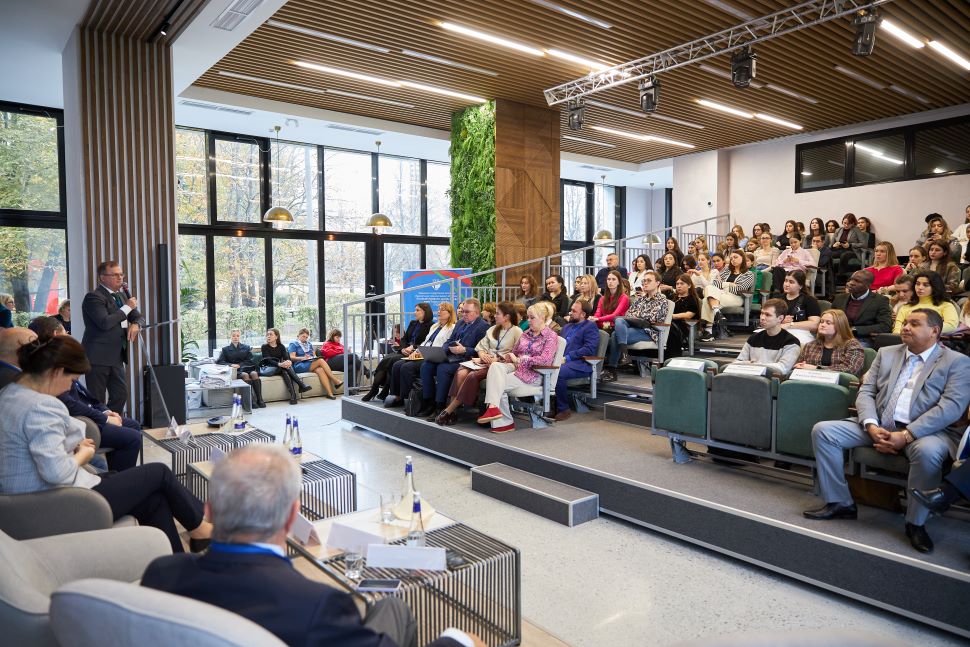
Institute of Medicine and Law Institute of RUDN set up a meeting to raise awareness of modern legal and ethical problems of the fields. The seminar was held in an “open microphone” format. After each presentation, participants could ask questions to the speakers.
At the seminar, lawyers, medical practitioners, representatives of public organisations and medical students discussed:
- human reproduction;
- activities of family-oriented hospitals;
- ethics and conflictology.
Victor Radzinsky, MD, Honoured Scientist of the Russian Federation, Corresponding Member of the Russian Academy of Sciences, Professor, Head of the Department of Obstetrics and Gynecology with Perinatology Course of the Institute of Medicine RUDN, delivered a report “Unresolved Issues of Reproductive Rights”. The speaker raised the issues of the worsening demographic situation in the world: decrease in the number of children in families, and aging of mankind as a whole. He also noted that insufficient time is devoted to sexuality education in high schools and universities of Russia. Victor also drew attention to the fact that the status of the embryo as an object or subject of law is not defined in the country. The professor believes that it is necessary to legislate the concept of “human reproductive rights” at the federal level in order to resolve these issues.
Diana Mustafina-Bredikhina, PhD in Law, Associate Professor of the Department of Administrative and Financial Law at the Law Institute of RUDN, is also concerned about the legal status of the embryo in Russia. In her report “Legal Aspects of Respect for the Reproductive Rights of the Individual: What Do Lawyers Suggest?” she informs that legal acts define an embryo as a human foetus from conception to 8 weeks, and also as a biomaterial. This problem leads to the “trade” of embryos, for which Diana proposes to introduce liability. The lack of a secured legal status also leads to litigation between parents who cannot reach a common denominator about the fate of embryos. The court frequently grants the genetic parent the status of an anonymous donor, but there is no unified practice. She concluded that it was impossible to establish human reproductive rights without establishing the status of the embryo. At the same time, it should not be an object of property rights.
Polina Vishnyakova, PhD in Biology, Deputy Head of the Laboratory of Molecular Pathophysiology at the Research Institute of Molecular and Cellular Medicine presented a report “A Biologist’s View: Man is the Beginning”. She highlighted that scientific advances in medicine give rise to many ethical problems. For instance, nowadays it is possible to give birth to a child from three parents: both two fathers and one mother and vice versa. Such techniques help prevent hereditary genetic diseases among children. However, in this case, parents may want “designer babies” and will “order” certain characteristics for their child. The speaker believes that such ethical problems should be foreseen and prevented by the medical and scientific communities at the development stage.
The participants also discussed the organisation of family-oriented hospitals’ work. Anna Karpova, M.D., delivered a report on “Practice of Neonatal Family-Oriented Hospitals and Application of Family-Oriented Methods: Experience of NICU of the Perinatal Centre of L. A. Vorokhobova State Clinical Hospital No. 67”. It is proved scientifically that joint stay of children with their parents has a positive effect on nursing of newborns, their recovery and development. Furthermore, constant presence with the child has a positive effect on the psycho-emotional state of the mother. The speaker believes that it is important to spread such practices throughout the country. According to Anna’s report, for this purpose it is necessary to improve the system of local regulations to ensure safe implementation of nursing techniques: “kangaroo”, skin-to-skin and others.
The scientific seminar “Happy Motherhood: Unresolved Problems of Obstetrics, Gynaecology and Perinatology” was supported by the Vladimir Potanin Foundation.
The first research and practical conference ‘Functional Morphology of the Tissue Microenvironment: From Theory to Practice’, dedicated to the memory of Academician Mikhail Paltsev of the Russian Academy of Sciences, was held at RUDN. It brought together leading researchers from Russia, China and other countries.
The Skolkovo Foundation (VEB.RF), together with the Ministry of Natural Resources and Environment of the Russian Federation and the country’s leading industrial companies, announced the launch of the sixth cycle of Russia’s largest supplier ecosystem development program for industry, GreenTech Sustainable Development. Applications from developers of technological solutions will be accepted until October 20, 2025.
In November, RUDN University hosted the country's first scientific and practical conference, “Clinical Laser Medicine in Russia: Advanced Technologies”. The event brought together specialists from various fields of medicine and biophotonics. It was attended by more than 300 scientists, researchers, and practicing doctors of various specialties from Russia and 32 foreign countries involved in laser technologies, as well as over 650 representatives of the younger generation—students, interns, graduate students, and young scientists.
The first research and practical conference ‘Functional Morphology of the Tissue Microenvironment: From Theory to Practice’, dedicated to the memory of Academician Mikhail Paltsev of the Russian Academy of Sciences, was held at RUDN. It brought together leading researchers from Russia, China and other countries.
The Skolkovo Foundation (VEB.RF), together with the Ministry of Natural Resources and Environment of the Russian Federation and the country’s leading industrial companies, announced the launch of the sixth cycle of Russia’s largest supplier ecosystem development program for industry, GreenTech Sustainable Development. Applications from developers of technological solutions will be accepted until October 20, 2025.
In November, RUDN University hosted the country's first scientific and practical conference, “Clinical Laser Medicine in Russia: Advanced Technologies”. The event brought together specialists from various fields of medicine and biophotonics. It was attended by more than 300 scientists, researchers, and practicing doctors of various specialties from Russia and 32 foreign countries involved in laser technologies, as well as over 650 representatives of the younger generation—students, interns, graduate students, and young scientists.