




Rats and neurodegenerative processes: a junior researcher at RUDN University wins Academician A. P. Avtsyn Award
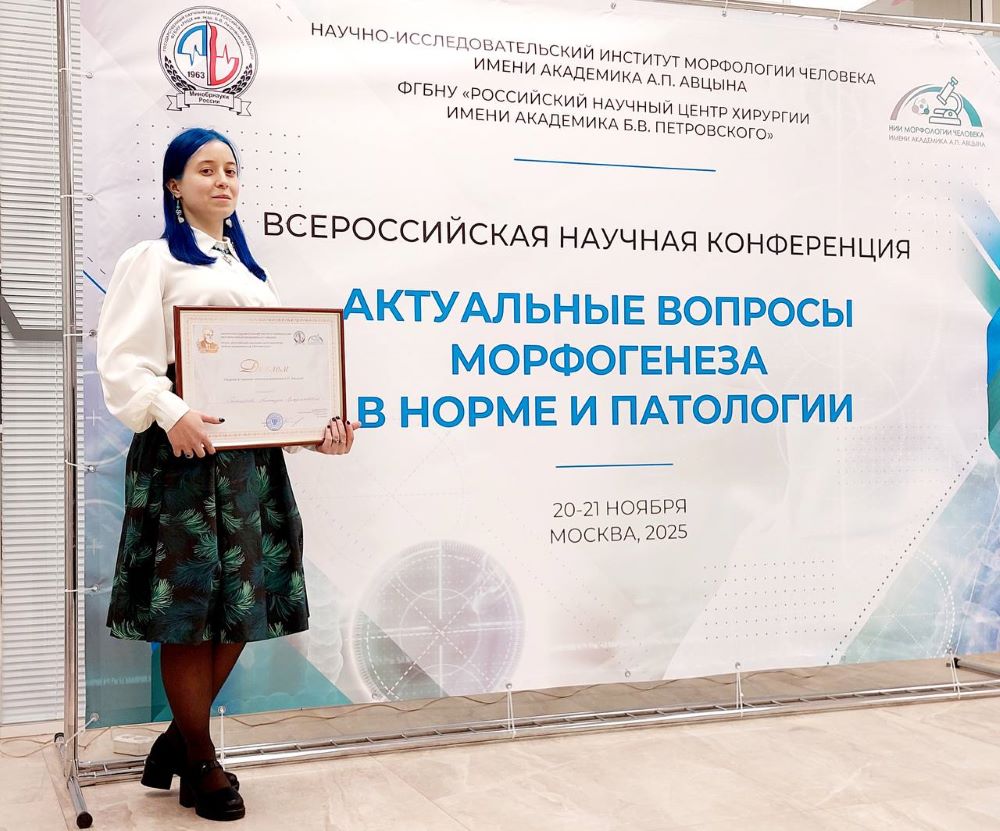
The research that earned Alexandra the award is devoted to the topic “The role of inflammation and microglial activation in the development of neurodegenerative processes induced by prolonged exposure to aluminum chloride in sexually mature and aged male Wistar rats.” The authors of the work also include Andrey Gerasimov, a graduate student at the RUDN Medical Institute (specializing in cell biology), and the scientific supervisor of the young scientists, Anna Kosyreva, Doctor of Sciences in Biology, leading researcher at the Laboratory of Cellular Biotechnology, professor at the Department of Histology, Cytology, and Embryology at RUDN University. We spoke with Alexandra and learned about the practical value of the research, the main discovery made during the work, and what winning this award means to her.
What is the scientific novelty and potential practical value of the research?
The practical value lies in confirming the need to model age-dependent, i.e., aging-associated, neurodegeneration specifically in older animals. There are relatively few such studies in the world, and they are often conducted using transgenic or knockout animals, in which the pathophysiological processes and the chronology of their occurrence differ radically from what happens in humans. We present a simple and accessible model that reproduces the molecular and cellular signs of neurodegeneration, as well as changes in the morphofunctional properties of microglia, the main immune cells of the central nervous system. Research into the role of microglia in the development of neurodegeneration is currently a trend. Our model of oxidative stress, to which humans, especially the elderly, are susceptible, can be used for preclinical research into approaches to the diagnosis and treatment of neurodegenerative diseases based on the effects on microglial cells.
What discoveries were made during this work? Were there any results that contradicted the initial hypotheses?
The model of neurodegeneration based on the effects of aluminum ions has been around for a long time, but previously it had only been described in young animals. Various articles have shown an increase in gene expression and protein synthesis in these animals, which are considered pathognomonic signs of Alzheimer's disease — amyloid precursor protein and amyloid aggregates. We reproduced these observations in our study. However, in older animals, these processes were more pronounced, as were changes in the morphological and functional properties of microglia cells, which came as a surprise to us. In young rats, we observed adaptation to oxidative stress, while in older rats, we observed pronounced maladaptation. We expected similar results, but what we got exceeded our expectations.
Are you planning to use this work as the basis for your doctoral dissertation or some other project?
This experiment is the subject of my doctoral dissertation. About half of the results of this work were included in the report presented at the conference.
Which reports or trends presented at the conference where the results of the competition were announced did you find most interesting?
An extremely interesting report on pharmacogenetics was presented by Academician of the Russian Academy of Sciences, Doctor of Medical Sciences, Professor Dmitry Alekseevich Sychev. For clinical practice, this is still a difficult area to implement, but it is very relevant. My research supervisor, Anna Mikhailovna, gave a presentation on the role of maternal immune activation in the development of neurogenesis disorders in offspring depending on gender. There is still little fundamental research in this area, but understanding these processes and the risks arising from infections suffered by pregnant women is extremely important for the management of such patients and for monitoring the development of neuropsychiatric diseases in children.
What does it mean for you personally to receive the Academician Avtsyn Award?
The Academician A.P. Avtsyn Award is recognition from colleagues, laboratory heads, and teachers with extensive experience, which is undoubtedly very valuable. It is also confirmation of the importance of our work and an incentive to continue developing it.
Imagine a world where everyone has enough food, clean water, access to education, and decent work. A world where nature is protected and the future of our planet is cared for. These are the Sustainable Development Goals—to achieve a sustainable future for all! To this end, in 2015, the United Nations (UN) defined 17 Sustainable Development Goals (SDGs). The SDGs are a global plan that helps countries and people work together towards a better future. All 193 UN member states have joined the plan.
Researchers from the Faculty of Artificial Intelligence at RUDN University conducted a large-scale study that revealed systemic errors in large language models (LLMs) when diagnosing depression based on text. This work, carried out in collaboration with colleagues from AIRI, Federal Research Center “Computer Science and Control” of the Russian Academy of Sciences, Ivannikov Institute for System Programming of the Russian Academy of Sciences, Moscow Institute of Physics and Technology, and MBZUAI, not only identifies the problem but also lays the foundation for the creation of more reliable and secure tools for detecting depression and anxiety.
The project to develop a cellular model of the placenta became the winner in the Scientific Materials category of the Young Scientists 3.0 competition, organized with the support of the Presidential Grants Foundation and T-Bank.
Imagine a world where everyone has enough food, clean water, access to education, and decent work. A world where nature is protected and the future of our planet is cared for. These are the Sustainable Development Goals—to achieve a sustainable future for all! To this end, in 2015, the United Nations (UN) defined 17 Sustainable Development Goals (SDGs). The SDGs are a global plan that helps countries and people work together towards a better future. All 193 UN member states have joined the plan.
Researchers from the Faculty of Artificial Intelligence at RUDN University conducted a large-scale study that revealed systemic errors in large language models (LLMs) when diagnosing depression based on text. This work, carried out in collaboration with colleagues from AIRI, Federal Research Center “Computer Science and Control” of the Russian Academy of Sciences, Ivannikov Institute for System Programming of the Russian Academy of Sciences, Moscow Institute of Physics and Technology, and MBZUAI, not only identifies the problem but also lays the foundation for the creation of more reliable and secure tools for detecting depression and anxiety.
The project to develop a cellular model of the placenta became the winner in the Scientific Materials category of the Young Scientists 3.0 competition, organized with the support of the Presidential Grants Foundation and T-Bank.