




Chemist Finds New Target For the Treatment of Neurodegenerative Consequences of High Blood Sugar
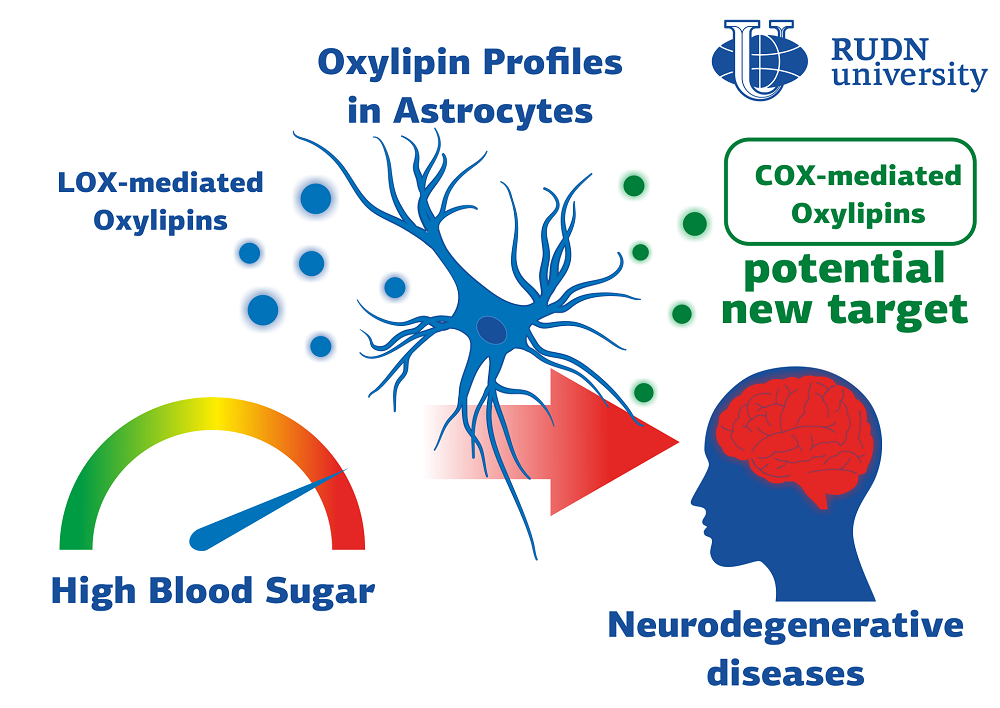
High blood sugar (hyperglycemia) can cause cognitive impairment, epilepsy and other neurodegenerative disorders. The main form of glucose storage in the body is glycogen. In the brain, it is stored mainly in nerve cells, astrocytes, which are formed from various polyunsaturated fatty acids. They “communicate” with each other, releasing signalling molecules — oxylipins. Until now, it was not known what happens to oxylipins when glucose levels increase. Chemists from the RUDN University and MSU have studied how hyperglycemia affects oxylipins and proposed a new therapeutic target for the treatment of brain disorders associated with hyperglycemia.
“Hyperglycemia is associated with several complications in the brain. igh glucose exposure causes astrocyte dysregulation, but its effects on the metabolism of oxylipins are relatively unknown and therefore, constituted the focus of our work”, said Sergey Goriainov, the Head of the Laboratory of Mass Spectrometry and High-resolution NMR Spectroscopy of RUDN’s Center for Collective Use.
To compare how the oxylipin profiles in the astrocytes change with different glucose levels, scientists took astrocytes from the brain of rats and placed them in an environment with normal (5.5 mmol) and high (25 mmol) glucose concentration. The biochemists then measured the profile of oxylipins using a high-performance liquid chromatography-mass spectrometer UPLC-MS/MS. Oxylipins were divided into two groups, depending on by which enzymes they were derived from their predecessors — polyunsaturated fatty acids. Then they statistically analyzed the data.
It turned out that with high glucose, the profile of oxylipins released by astrocytes changes. In an environment with a high concentration of glucose, there were about four times more oxylipins, which were obtained by cyclooxygenase (COX). At normal sugar levels, COX-oxylipins were about five picograms per milligram, and about 20at high levels. For comparison, the level of oxylipins, derived by another enzyme (lipoxygenase, LOX), hardly changed depending on the glucose level and remained at 1-3 picograms per milligram. Scientists have concluded that COX-oxylipins may become a new direction for the treatment of brain disorders that occur due to hyperglycemia.
“The data suppose a regulation of COX-mediated oxylipin synthesis as a potential new target in the treatment of brain impairment associated with hyperglycemia”, said Sergey Goriainov, the Head of the Laboratory of Mass Spectrometry and High-resolution NMR Spectroscopy of RUDN’s Center for Collective Use.
The results are published in Metabolites.
In the last five years, academic staff of RUDN alongside the Chinese universities and research centers has achieved impressive results. More than 1,000 scientific publications were made jointly in a wide spectrum from engineering and technology to medicine and social sciences. 19 of these materials were published in top-rated journals which verifies that the works were world-class level.
RUDN University has been included among the leaders in the BRICS ESG University Ranking among 65 leading universities. They were assessed on 20 criteria, ranging from education and research to environmental and social agendas.
At a meeting of the new RUDN University Dissertation Council in the specialties of 2.1.12 “Architecture of Buildings and Structures. Creative Concepts of Architectural Activity” and 2.1.11 “Theory and History of Architecture, Restoration and Reconstruction of Historical and Architectural Heritage”, three postgraduate students — Natalia Kalinina, Evgeny Ogienko, and Yulia Loginova — were awarded PhD degrees in Architecture for the first time in the university's history.