




“Our technique allows us to do express analysis and select high-quality medicinal plant materials, which means improving the quality of drugs based on them,” - Vera Zhilkina, IBCTN, RUDN University
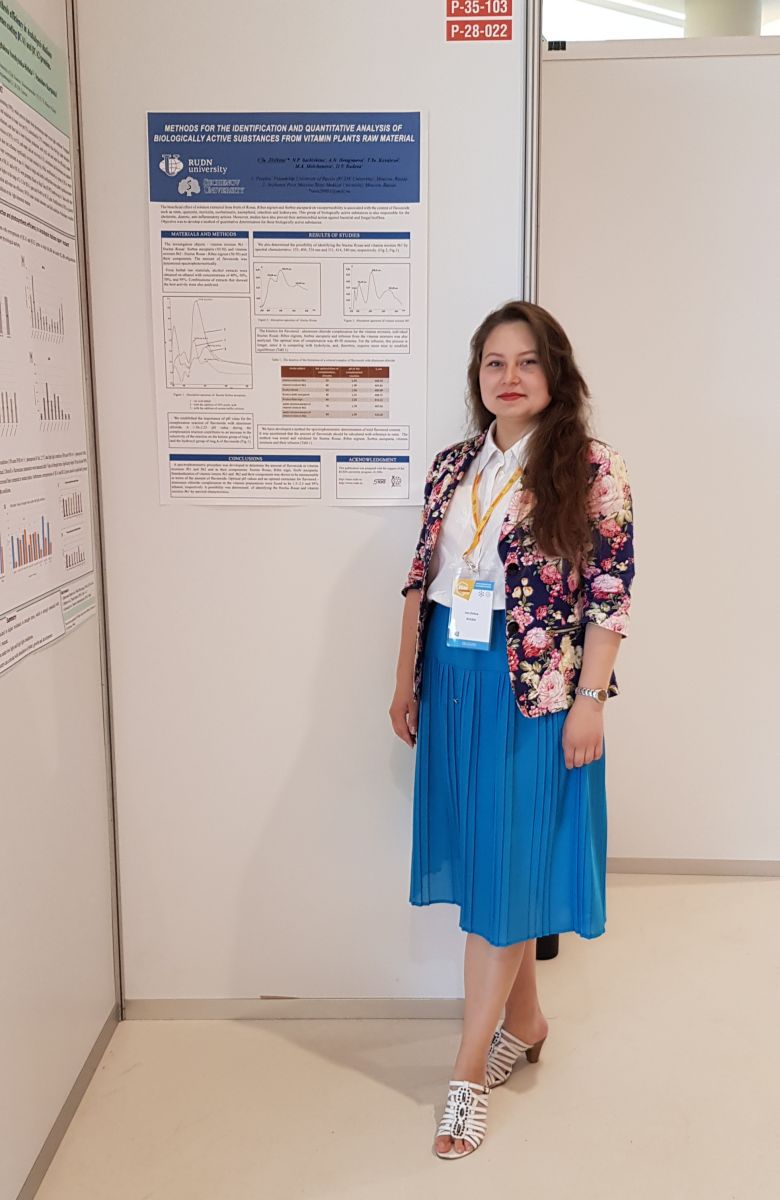 July 6-11, Poland hosted the 44th Congress of the Federation of European Biochemical Societies “From molecules to living systems” bringing together scientists from Austria, Brazil, Germany, Spain, Italy, the USA, France, Sweden and other countries. RUDN University was presented by researchers from the Institute of Biochemical Technology and Nanotechnology (IBCTN) – assistant lecturer Vera Zhilkina and graduate student Anastasia Stoynova.
Among the key topics of the congress are plant biotechnology, bionanotechnology, polymer synthesis for biomedicine, synthetic networks and systems, analysis and visualization of individual cells, women in science, education in the field of biochemistry and molecular biology. Vera Zhilkina made a presentation “Methods for the identification and quantitative analysis of biologically active substances from vitamin plants raw material” in the section “Plant biotechnology”. Abstracts were published in a special issue of FEBS Open Bio, indexed in WoS.
“In the production of medicines from plant materials, standardization is important - what parameters to use for standardization, whether it is possible to use the material, what is the chemical composition of the raw materials, how many biologically active substances - for example, flavonoids there are. Using the example of wild rose and vitamin brew No. 1, we have proved the effectiveness of the spectral identification technique for three absorption maxima. This technique allows for express analysis and selection of high-quality medicinal plant materials, which means improving the quality of drugs. We also established parameters that increase the selectivity of the method in the quantitative analysis of raw materials and preparations based on them. We patented this technique, so the result of the work of a full scientific cycle was presented at the Congress, ” said Vera Zhilkina, Assistant lecturer of the Institute of Biochemical and Nanotecnology.
Anastasia Stoynova made a report “Diagnosis of the thyroid gland diseases: nanotechnology in the development of diagnostic test systems” in the section “Bionanotechnology”.
“The goal of the FEBS community is to organize an international forum for the direct exchange of knowledge and ideas in the field of molecular life sciences. The event has become a successful platform for close international cooperation and scientific collaborations,” said Anastasia Stoynova, graduate student of IBCTN, RUDN University.
In the last five years, academic staff of RUDN alongside the Chinese universities and research centers has achieved impressive results. More than 1,000 scientific publications were made jointly in a wide spectrum from engineering and technology to medicine and social sciences. 19 of these materials were published in top-rated journals which verifies that the works were world-class level.
RUDN University has been included among the leaders in the BRICS ESG University Ranking among 65 leading universities. They were assessed on 20 criteria, ranging from education and research to environmental and social agendas.
At a meeting of the new RUDN University Dissertation Council in the specialties of 2.1.12 “Architecture of Buildings and Structures. Creative Concepts of Architectural Activity” and 2.1.11 “Theory and History of Architecture, Restoration and Reconstruction of Historical and Architectural Heritage”, three postgraduate students — Natalia Kalinina, Evgeny Ogienko, and Yulia Loginova — were awarded PhD degrees in Architecture for the first time in the university's history.