




The symbiosis of sciences: how mathematical analysis creates tools for medicine
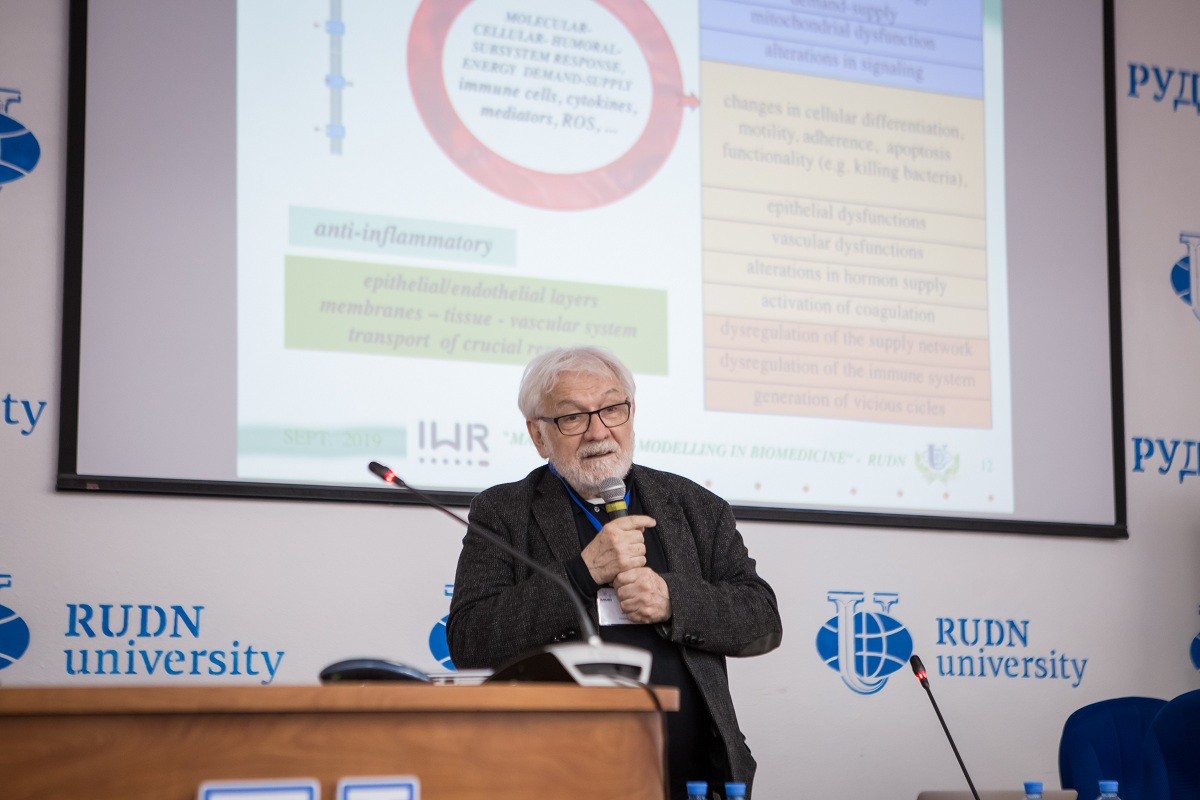
Mathematical modeling in medicine provides an in-depth analysis of normal and pathological processes in the human body. At RUDN, modern issues of medicine and healthcare were discussed by physicians, biophysicists, mathematicians, and computer modeling specialists. The conference was attended by well-known scientists - mathematicians and physicians: Willy Jager, Gennady Bocharov, Philip Miney, Wolf Wiland, Vitaly Volpert.
The aim of mathematical modeling is to predict the behavior of the system under various external influences. The conference presented the latest research achievements in the field of mathematical modeling in biomedicine, including cardiovascular diseases, immunology and infectious diseases, mathematical oncology. Modeling methods and mathematical analysis of the corresponding models were also discussed.
Scientists also discussed studies of the mechanisms of cancer and infectious diseases. In addition, several sections were devoted to the problems of mathematical modeling in biomedicine: problems of comparison with experimental data, theory of active media, and mathematical analysis of biomedical models.
Many principles of theoretical approaches to solving problems developed in one area can be transferred to others. In particular, the theory of active media, which has long been used in the problems of the spread of excitation in the heart, is now beginning to be applied in solving the problems of blood coagulation, the development of oncology and the development of infection in the body, which gives fundamentally new knowledge about physiology and the possibilities of therapy. Thus, the conference served as a catalyst for the development of new areas in science.
The first research and practical conference ‘Functional Morphology of the Tissue Microenvironment: From Theory to Practice’, dedicated to the memory of Academician Mikhail Paltsev of the Russian Academy of Sciences, was held at RUDN. It brought together leading researchers from Russia, China and other countries.
The Skolkovo Foundation (VEB.RF), together with the Ministry of Natural Resources and Environment of the Russian Federation and the country’s leading industrial companies, announced the launch of the sixth cycle of Russia’s largest supplier ecosystem development program for industry, GreenTech Sustainable Development. Applications from developers of technological solutions will be accepted until October 20, 2025.
In November, RUDN University hosted the country's first scientific and practical conference, “Clinical Laser Medicine in Russia: Advanced Technologies”. The event brought together specialists from various fields of medicine and biophotonics. It was attended by more than 300 scientists, researchers, and practicing doctors of various specialties from Russia and 32 foreign countries involved in laser technologies, as well as over 650 representatives of the younger generation—students, interns, graduate students, and young scientists.
The first research and practical conference ‘Functional Morphology of the Tissue Microenvironment: From Theory to Practice’, dedicated to the memory of Academician Mikhail Paltsev of the Russian Academy of Sciences, was held at RUDN. It brought together leading researchers from Russia, China and other countries.
The Skolkovo Foundation (VEB.RF), together with the Ministry of Natural Resources and Environment of the Russian Federation and the country’s leading industrial companies, announced the launch of the sixth cycle of Russia’s largest supplier ecosystem development program for industry, GreenTech Sustainable Development. Applications from developers of technological solutions will be accepted until October 20, 2025.
In November, RUDN University hosted the country's first scientific and practical conference, “Clinical Laser Medicine in Russia: Advanced Technologies”. The event brought together specialists from various fields of medicine and biophotonics. It was attended by more than 300 scientists, researchers, and practicing doctors of various specialties from Russia and 32 foreign countries involved in laser technologies, as well as over 650 representatives of the younger generation—students, interns, graduate students, and young scientists.