




RUDN at VUZPROMEXPO-2020 exhibition: Key Projects and Developments
What projects and developments were presented by our University?
Project 1: “Territory” web-application
Applied solutions in the field of processing and integration in a unified geospace of large volumes of heterogeneous operational, retrospective and thematic remote sensing data using digital, intelligent technologies and artificial intelligence
- Industry Management Center of the Faculty of Economics of RUDN University.
- Partners: Roscosmos, — Roscosmos, Joint Stock Company “Russian Space Systems”
The project team developed the “Territory” web application. It is based on algorithms based on neural networks. The first and most important advantage of using it is saving time, because the work of a human analyst takes a longer period of time. The maximum time to complete a task for “Territory” is 3.5 minutes. The application allows to automate the processing of large data from remote sensing of the Earth and generate analytical materials. This is necessary to solve a wide range of management tasks in various segments of digital economy, in construction, forestry and subsurface management.
Project 2: Monitoring system of the status of green spaces
- RUDN Agrarian and Technological Institute
- Partners: Euro-Mediterranean Center on Climate Change, The Government of Moscow
RUDN agrarians have created an on-line monitoring system. It can assess the condition of trees and give an accurate forecast; it can predict what will happen to the tree in the future. On this basis, scientists can develop recommendations for maintaining trees in urban environment and care of green spaces. RUDN scientists have created:
Two types of sensors for free condition monitoring.
- A system for collecting, transmitting and storing primary data.
- A working monitoring network and database. It stores values of micrometeorological parameters, parameters of physiological state and vertical stability for more than 200 trees of different species, ages and growing conditions.
Project 3: Mathematical modeling in biomedicine
- Faculty of Physical, Mathematical and Natural Sciences of RUDN, S.M. Nikol’skii Mathematical Institute
RUDN scientists have created a mathematical model of the cardiovascular system with a detailed description of the mechanics of cardiac contraction. It shows the electromechanical and mechanochemical processes that take place in the cardiac muscle cell. The results of the study of the mathematical model are compared with the available data and then used to predict and optimize the treatment of diseases, which are the main causes of mortality in the population.
Also, at the exhibition, RUDN presented the promising developments of scientific and student teams, implemented with the support of the 5-100 project.
- Technologies of improvement and advancement of the main network systems indicators, and the Tactile Internet. Faculty of Physical, Mathematical and Natural Sciences of RUDN, Applied Mathematics & Communications Technology Institute
- New approaches in pharmaceutical technologies (dosage forms, medicines). Common Use Center (Research and Educational Center) of RUDN
- Nano- and Cellular Technologies in Biomedicine. RUDN Institute of Biochemical Technology and Nanotechnology
- Polymeric sorbent for cleaning water from oil products with high capacity for oils and other petroleum products (more than 30 g/g), the possibility of regeneration for solving problems of sewage treatment, process water and wastewater from various enterprises. Faculty of Physical, Mathematical and Natural Sciences of RUDN, Department of Physical and Colloid Chemistry
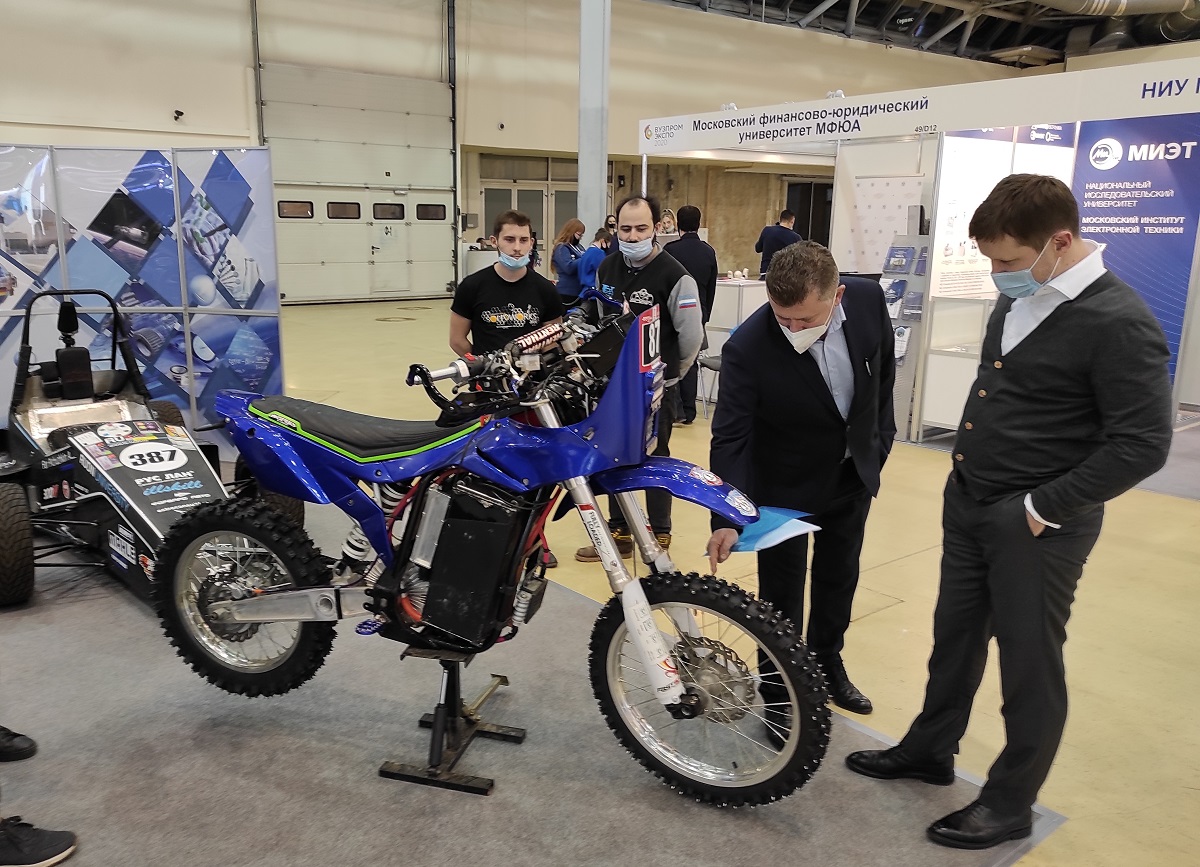
- SAE Formula Student international competition class racing car designed by students. Smartmoto Challenge international competition class motorcycle designed by students using the latest 3D printing and artificial intelligence technology. RUDN Institute of Innovative Engineering Technologies
At the opening ceremony of “VUZPROMEXPO” the Minister of Science and Higher Education of the Russian Federation Valery Falkov noted that the main idea of the exhibition was to show the results of cooperation between Russian science, Russian higher education and industry. It is the interaction of Russian science and higher education with the industry that is one of the priorities of the long-term strategy until 2030.
During the exhibition an intensive business program were held:
- more than 40 panel discussions and roundtables, where the results of the national project “Science” in 2020,
- discussing algorithms for launching the renewed national project “Science and Universities” and the federal projects that are part of it,
- panel discussions on the digital transformation of education, and other topical issues for Russian science and higher education.
The events of the exhibition were attended by representatives of federal executive authorities, educational and scientific organizations, industrial enterprises.
General information:
VUZPROMEXPO exhibition is a large-scale and representative platform for demonstration of Russian science achievements and building of effective communication between the scientific and educational community, the state and business. It has been held since 2013. The exhibition is a reporting event of the Ministry of Science and Higher Education of the Russian Federation to demonstrate the results of the national projects “Science” and “Education” and a launching pad for hundreds of scientific developments successfully implemented into production today.
Prepared with materials from http://vuzpromexpo.ru/
RUDN participation at the exhibition is supported within the framework of the federal project “5-100” aimed to increase the competitive ability of the leading Russian universities.
The first research and practical conference ‘Functional Morphology of the Tissue Microenvironment: From Theory to Practice’, dedicated to the memory of Academician Mikhail Paltsev of the Russian Academy of Sciences, was held at RUDN. It brought together leading researchers from Russia, China and other countries.
The Skolkovo Foundation (VEB.RF), together with the Ministry of Natural Resources and Environment of the Russian Federation and the country’s leading industrial companies, announced the launch of the sixth cycle of Russia’s largest supplier ecosystem development program for industry, GreenTech Sustainable Development. Applications from developers of technological solutions will be accepted until October 20, 2025.
In November, RUDN University hosted the country's first scientific and practical conference, “Clinical Laser Medicine in Russia: Advanced Technologies”. The event brought together specialists from various fields of medicine and biophotonics. It was attended by more than 300 scientists, researchers, and practicing doctors of various specialties from Russia and 32 foreign countries involved in laser technologies, as well as over 650 representatives of the younger generation—students, interns, graduate students, and young scientists.
The first research and practical conference ‘Functional Morphology of the Tissue Microenvironment: From Theory to Practice’, dedicated to the memory of Academician Mikhail Paltsev of the Russian Academy of Sciences, was held at RUDN. It brought together leading researchers from Russia, China and other countries.
The Skolkovo Foundation (VEB.RF), together with the Ministry of Natural Resources and Environment of the Russian Federation and the country’s leading industrial companies, announced the launch of the sixth cycle of Russia’s largest supplier ecosystem development program for industry, GreenTech Sustainable Development. Applications from developers of technological solutions will be accepted until October 20, 2025.
In November, RUDN University hosted the country's first scientific and practical conference, “Clinical Laser Medicine in Russia: Advanced Technologies”. The event brought together specialists from various fields of medicine and biophotonics. It was attended by more than 300 scientists, researchers, and practicing doctors of various specialties from Russia and 32 foreign countries involved in laser technologies, as well as over 650 representatives of the younger generation—students, interns, graduate students, and young scientists.