




A RUDN University physicist simplified the Einstein-lovelock theory for black holes
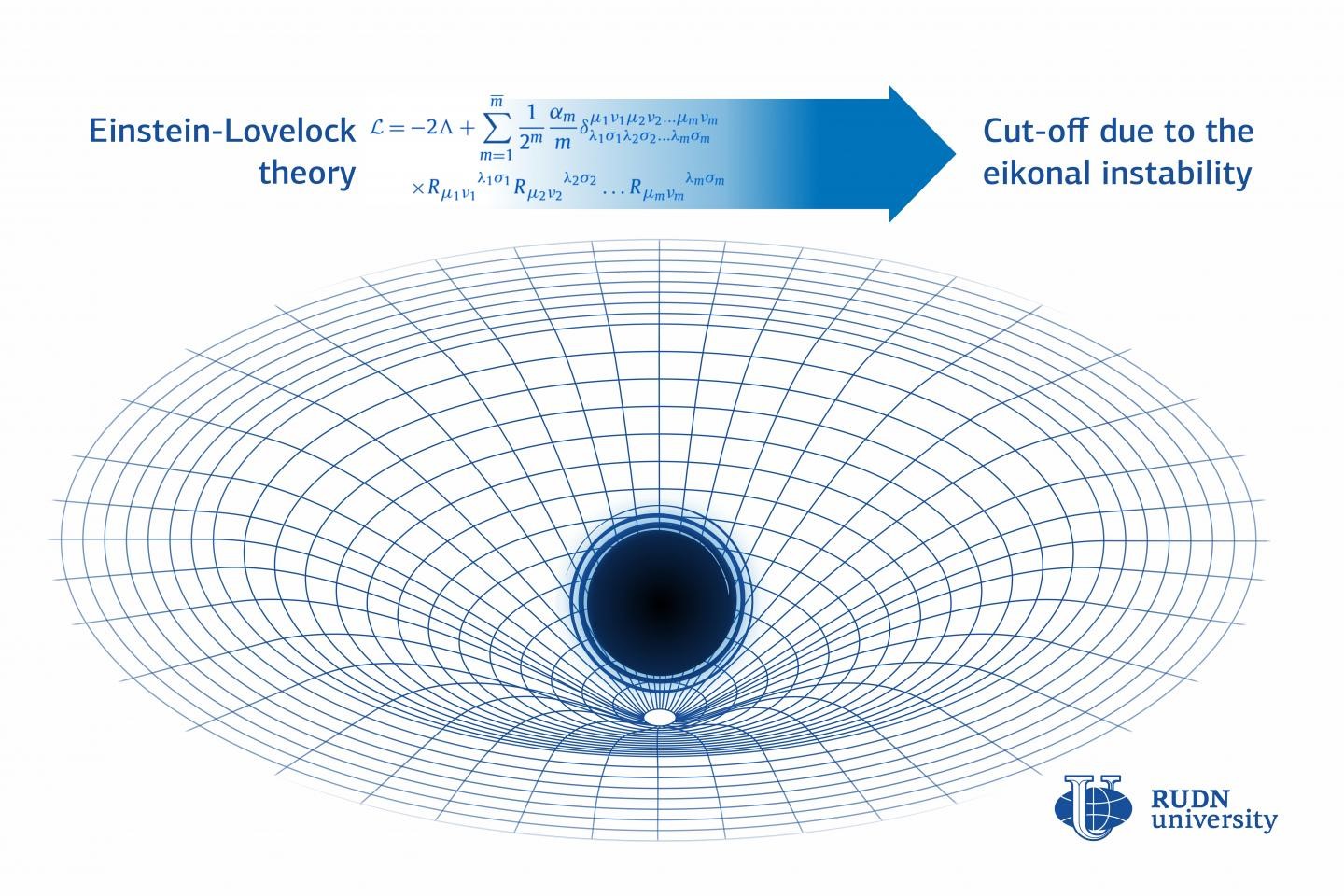
Einstein’s general theory of relativity predicted the existence of black holes—supermassive objects in the Universe that attract everything, including light. Black holes are described by many mathematical models, one of which is the Einstein-Lovelock theory that imposes quantum corrections to elaborate on the general theory of relativity. In it, a black hole is described by a sum of an infinite number of terms. However, a physicist from RUDN University confirmed that a limited number of terms can suffice to describe the effects observed in the vicinity of a black hole. Other components of the equation have a negligibly small contribution that can be ignored. This would considerably simplify calculations and help researchers study black holes in theories with quantum corrections.
According to Einstein’s theory, heavy objects warp space-time—a 4D construction that has three spatial and one temporal dimension. In 1971, Lovelock generalized this theory to include any number of dimensions. The Einstein-Lovelock equation is an infinite sum: the first two terms in it are Einstein’s representation, and each subsequent one details the space-time curvature.
Each term in the Einstein-Lovelock equation is multiplied by the so-called coupling constant. According to the physicist from RUDN University, if one sticks to the positive values of coupling constants, high curvature corrections can be ’cut off’. This is due to the fact that each coupling constant has a critical value: after it is reached, a black hole becomes unstable, i.e. unable to exist in reality. Such a representation is still possible from the point of view of mathematics but has no physical sense. The more terms, the lower is the critical value for coupling constants. Therefore the stability of a black hole (i.e. the possibility of its physical existence) can be used as a criterion to remove redundant terms.
“With every new Lovelock’s term, the critical value of coupling constants becomes lower. This is an important observation: it confirms that in order to find the biggest possible correction to black hole geometry caused by a newly added Lovelock’s term, all other terms can be considered negligibly small,” said Roman Konoplya, a researcher at the Academic Research Institute for Gravitation and Cosmology, RUDN University.
According to the scientist and his team, the main observable values (such as the radius of a black hole shadow) remain virtually unchanged when the Lovelock corrections of higher than the fourth order in curvature are included. These findings can be useful not only for studying processes in the black holes but also for confirming theoretical predictions associated with possible generalizations of Einstein’s theory.
The article was published in Physics Letters B.
Imagine a world where everyone has enough food, clean water, access to education, and decent work. A world where nature is protected and the future of our planet is cared for. These are the Sustainable Development Goals—to achieve a sustainable future for all! To this end, in 2015, the United Nations (UN) defined 17 Sustainable Development Goals (SDGs). The SDGs are a global plan that helps countries and people work together towards a better future. All 193 UN member states have joined the plan.
Researchers from the Faculty of Artificial Intelligence at RUDN University conducted a large-scale study that revealed systemic errors in large language models (LLMs) when diagnosing depression based on text. This work, carried out in collaboration with colleagues from AIRI, Federal Research Center “Computer Science and Control” of the Russian Academy of Sciences, Ivannikov Institute for System Programming of the Russian Academy of Sciences, Moscow Institute of Physics and Technology, and MBZUAI, not only identifies the problem but also lays the foundation for the creation of more reliable and secure tools for detecting depression and anxiety.
Alexandra Sentyabreva, a junior researcher at the Laboratory of Cell Technologies and Tissue Engineering at RUDN Research Institute of Molecular and Cellular Medicine at the Russian University of People's Friendship, won the competition for young scientists at the All-Russian Scientific Conference “Topical Issues of Morphogenesis in Norm and Pathology.” She was awarded the Academician A.P. Avtsyn Prize.
Imagine a world where everyone has enough food, clean water, access to education, and decent work. A world where nature is protected and the future of our planet is cared for. These are the Sustainable Development Goals—to achieve a sustainable future for all! To this end, in 2015, the United Nations (UN) defined 17 Sustainable Development Goals (SDGs). The SDGs are a global plan that helps countries and people work together towards a better future. All 193 UN member states have joined the plan.
Researchers from the Faculty of Artificial Intelligence at RUDN University conducted a large-scale study that revealed systemic errors in large language models (LLMs) when diagnosing depression based on text. This work, carried out in collaboration with colleagues from AIRI, Federal Research Center “Computer Science and Control” of the Russian Academy of Sciences, Ivannikov Institute for System Programming of the Russian Academy of Sciences, Moscow Institute of Physics and Technology, and MBZUAI, not only identifies the problem but also lays the foundation for the creation of more reliable and secure tools for detecting depression and anxiety.
Alexandra Sentyabreva, a junior researcher at the Laboratory of Cell Technologies and Tissue Engineering at RUDN Research Institute of Molecular and Cellular Medicine at the Russian University of People's Friendship, won the competition for young scientists at the All-Russian Scientific Conference “Topical Issues of Morphogenesis in Norm and Pathology.” She was awarded the Academician A.P. Avtsyn Prize.