




RUDN University Chemists Revealed the Potential of NMR Spectroscopy For Microalgae Study
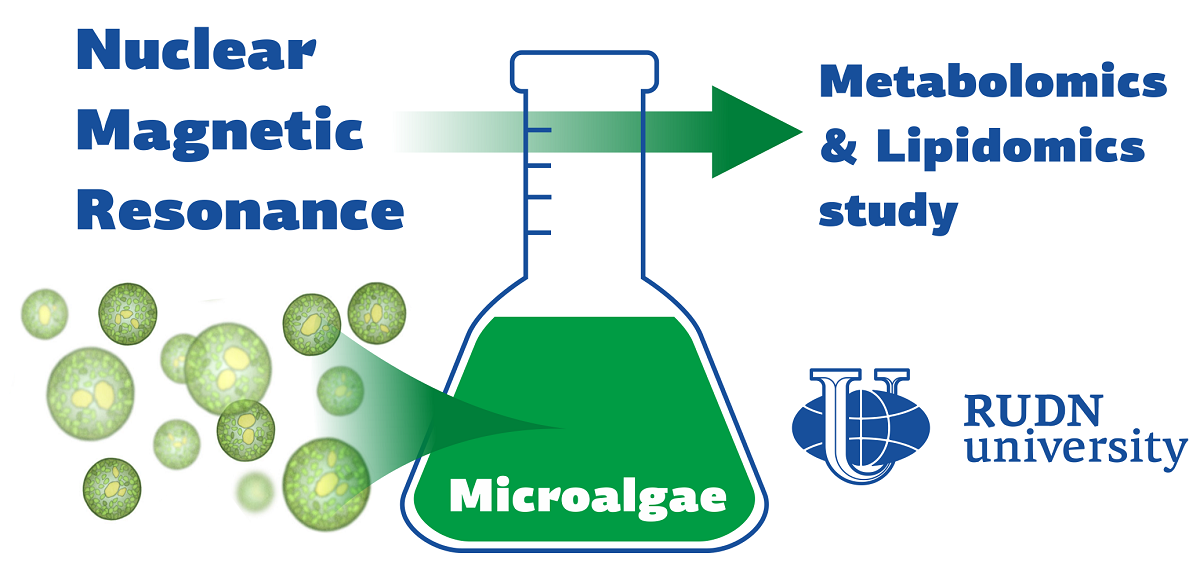
Microalgae are used as sources of bioactive substances — they produce secondary metabolites. These substances are useful in different areas, from cosmetology to the chemical industry and energetics. To determine the composition and amount of metabolites, they use the phenomenon of nuclear magnetic resonance (NMR), that is producing of electromagnetic signal when the magnetic moment of the nucleus changes. RUDN University chemists, together with colleagues from India, collected research on the use of NMR spectroscopy for the analysis of microalgae and outlined the most effective protocols and promising areas.
“Microalgal biotechnology has emerged that allows the continuous development of microalgae on a commercial scale due to its enormous biodiversity of bioactive components in various applications. Recent progress also unlocked microalgae potentials to uncover a range of novel metabolic capabilities such as fix atmospheric carbon dioxide, valorize waste resources, and turn them into bio-products such as health, cosmetics and natural products for the development towards sustainable bio-refinery. NMR has been one of the top three analytical methods in metabolomics and lipidomics.,” said Vinod Kumar, RUDN University professor.
Chemists analyzed more than 50 papers on this topic. Among the advantages of nuclear magnetic resonance chemists named, for example, the ability to conduct several experiments with a single sample, since NMR does not destroy it. Moreover, NMR requires minimal sample preparation and can detect even previously unknown compounds. However, this method has its drawbacks. NMR is less likely to detect compounds with high molecular weight (such as long chains of fats). In addition, in the graphical representation, the peaks corresponding to different compounds can overlap each other. This makes analysis difficult.
RUDN University chemists concluded that the only way to increase the efficiency of metabolic analysis (to identify as many metabolites as possible) is to use a combination of mass spectroscopy and NMR. Nuclear magnetic resonance helps finding unknown compounds, which can then be accurately searched for in other samples using mass spectroscopy.
“The results obtained by quantitative mass spectroscopy methods are often complementary to those obtained by NMR, with MS methods being better at detecting hydrophobic molecules and NMR being better at detecting hydrophilic molecules of microalgae,” said Vinod Kumar, RUDN University professor.
The results are published in Archives of Biochemistry and Biophysics.
Imagine a world where everyone has enough food, clean water, access to education, and decent work. A world where nature is protected and the future of our planet is cared for. These are the Sustainable Development Goals—to achieve a sustainable future for all! To this end, in 2015, the United Nations (UN) defined 17 Sustainable Development Goals (SDGs). The SDGs are a global plan that helps countries and people work together towards a better future. All 193 UN member states have joined the plan.
Researchers from the Faculty of Artificial Intelligence at RUDN University conducted a large-scale study that revealed systemic errors in large language models (LLMs) when diagnosing depression based on text. This work, carried out in collaboration with colleagues from AIRI, Federal Research Center “Computer Science and Control” of the Russian Academy of Sciences, Ivannikov Institute for System Programming of the Russian Academy of Sciences, Moscow Institute of Physics and Technology, and MBZUAI, not only identifies the problem but also lays the foundation for the creation of more reliable and secure tools for detecting depression and anxiety.
Alexandra Sentyabreva, a junior researcher at the Laboratory of Cell Technologies and Tissue Engineering at RUDN Research Institute of Molecular and Cellular Medicine at the Russian University of People's Friendship, won the competition for young scientists at the All-Russian Scientific Conference “Topical Issues of Morphogenesis in Norm and Pathology.” She was awarded the Academician A.P. Avtsyn Prize.
Imagine a world where everyone has enough food, clean water, access to education, and decent work. A world where nature is protected and the future of our planet is cared for. These are the Sustainable Development Goals—to achieve a sustainable future for all! To this end, in 2015, the United Nations (UN) defined 17 Sustainable Development Goals (SDGs). The SDGs are a global plan that helps countries and people work together towards a better future. All 193 UN member states have joined the plan.
Researchers from the Faculty of Artificial Intelligence at RUDN University conducted a large-scale study that revealed systemic errors in large language models (LLMs) when diagnosing depression based on text. This work, carried out in collaboration with colleagues from AIRI, Federal Research Center “Computer Science and Control” of the Russian Academy of Sciences, Ivannikov Institute for System Programming of the Russian Academy of Sciences, Moscow Institute of Physics and Technology, and MBZUAI, not only identifies the problem but also lays the foundation for the creation of more reliable and secure tools for detecting depression and anxiety.
Alexandra Sentyabreva, a junior researcher at the Laboratory of Cell Technologies and Tissue Engineering at RUDN Research Institute of Molecular and Cellular Medicine at the Russian University of People's Friendship, won the competition for young scientists at the All-Russian Scientific Conference “Topical Issues of Morphogenesis in Norm and Pathology.” She was awarded the Academician A.P. Avtsyn Prize.