




RUDN chemists have created catalysts for cheap and efficient synthesis of propylene and ethylene
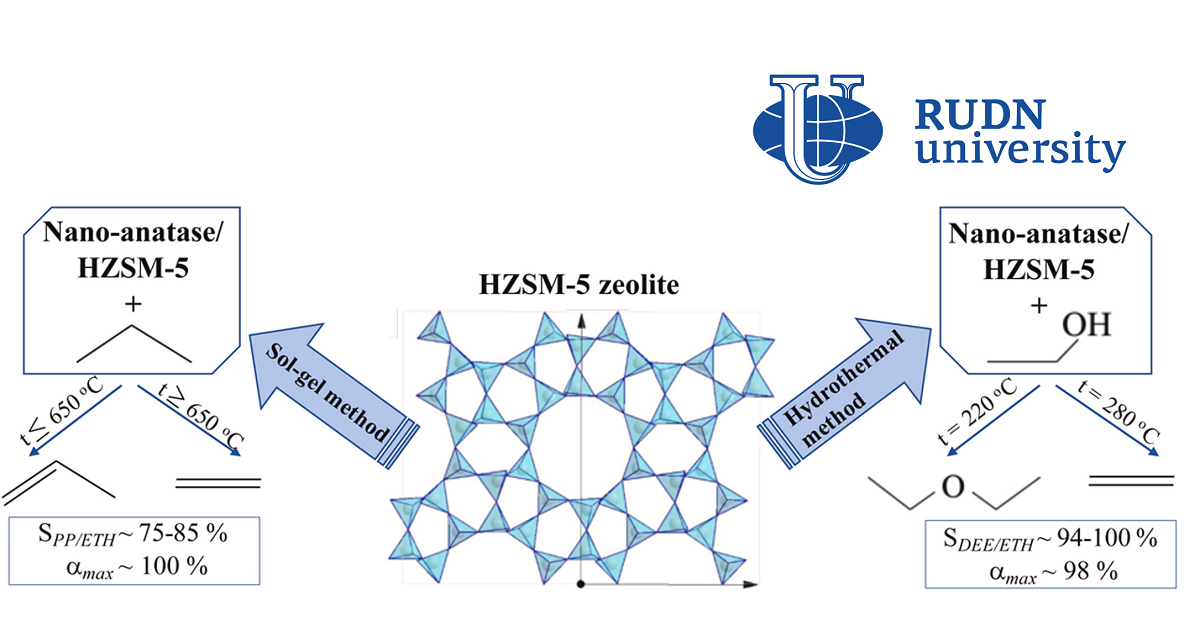
Propylene is used in the production of films, pipes, food packaging, insulation materials and bags, and ethylene is an important intermediate in the chemical industry. They are produced mainly from shale gas, but chemists are looking for ways to synthesize them from propane. This source should give more output, but this requires catalysts that may be unstable or too expensive, difficult to manufacture. Some of them create toxic reaction byproducts, others need a high temperature to work. Zeolites are a large group of calcium aluminosilicates. They can trigger the conversion of propane to propylene and ethanol to ethylene in a way that differs from reactions with other catalysts. This allows the reaction to be carried out at lower temperatures, which makes the process more convenient and cheaper. In addition, their activity can be adjusted depending on temperature, material composition, modification method and other conditions. Zeolite-based catalysts HZSM-5 can directly “take away” hydrogen from propane to make propylene.
“We investigated how the structure and texture features of HZSM-5 zeolites and their composites with anatase mineral nanoparticles affect their catalytic activity in reactions with propane at high temperature and with liquid ethanol at medium temperature,” — Ekaterina Markova, Candidate of Chemical Sciences from RUDN.
RUDN chemists have created, tested and characterized various modifications of HZSM-5 zeolite in order to choose the best options for industrial production. The mineral anatase is one of the natural modifications of titanium dioxide, which is often found in crystal deposits. Chemists for the first time obtained catalysts from HZSM-5 zeolites and anatase nanoparticles using hydrothermal synthesis and sol-gel technology. As a result, new functional groups appeared in zeolites, the texture of the surface of the particles and the size of the pores changed, which also affected their activity. The characteristics of these catalysts were studied from different angles, and then their effect on ethanol and propane was tested.
If for the initial form of HZSM-5 zeolites and propane the maximum selectivity was 75% at a temperature of 650 ° C, then with anatase nanoparticles the selectivity increased to 85%. In the reaction with ethanol, zeolites with nanoparticles helped to reduce the reaction temperature and bring the production to 94-100%. At the same time, the catalysts that were obtained using sol-gel technology turned out to be more active in reactions with propane, and the results of hydrothermal synthesis were better suited for working with ethanol.
“The addition of anatase nanoparticles, the number and volume of pores of different sizes, the content of hydroxyl groups and other characteristics affect the operation of catalysts. This will allow us to control the course of reactions, the mechanisms of which we have also studied. Our catalysts are no less or even more active than commercially available analogues, but they are easier to manufacture. In addition, they are cheaper and allow you to more accurately control the production process of ethylene and propylene,” — Candidate of Chemical Sciences Anna Zhukova, Associate Professor of the Department of Physical and Colloidal Chemistry of the RUDN.
Imagine a world where everyone has enough food, clean water, access to education, and decent work. A world where nature is protected and the future of our planet is cared for. These are the Sustainable Development Goals—to achieve a sustainable future for all! To this end, in 2015, the United Nations (UN) defined 17 Sustainable Development Goals (SDGs). The SDGs are a global plan that helps countries and people work together towards a better future. All 193 UN member states have joined the plan.
Researchers from the Faculty of Artificial Intelligence at RUDN University conducted a large-scale study that revealed systemic errors in large language models (LLMs) when diagnosing depression based on text. This work, carried out in collaboration with colleagues from AIRI, Federal Research Center “Computer Science and Control” of the Russian Academy of Sciences, Ivannikov Institute for System Programming of the Russian Academy of Sciences, Moscow Institute of Physics and Technology, and MBZUAI, not only identifies the problem but also lays the foundation for the creation of more reliable and secure tools for detecting depression and anxiety.
Alexandra Sentyabreva, a junior researcher at the Laboratory of Cell Technologies and Tissue Engineering at RUDN Research Institute of Molecular and Cellular Medicine at the Russian University of People's Friendship, won the competition for young scientists at the All-Russian Scientific Conference “Topical Issues of Morphogenesis in Norm and Pathology.” She was awarded the Academician A.P. Avtsyn Prize.
Imagine a world where everyone has enough food, clean water, access to education, and decent work. A world where nature is protected and the future of our planet is cared for. These are the Sustainable Development Goals—to achieve a sustainable future for all! To this end, in 2015, the United Nations (UN) defined 17 Sustainable Development Goals (SDGs). The SDGs are a global plan that helps countries and people work together towards a better future. All 193 UN member states have joined the plan.
Researchers from the Faculty of Artificial Intelligence at RUDN University conducted a large-scale study that revealed systemic errors in large language models (LLMs) when diagnosing depression based on text. This work, carried out in collaboration with colleagues from AIRI, Federal Research Center “Computer Science and Control” of the Russian Academy of Sciences, Ivannikov Institute for System Programming of the Russian Academy of Sciences, Moscow Institute of Physics and Technology, and MBZUAI, not only identifies the problem but also lays the foundation for the creation of more reliable and secure tools for detecting depression and anxiety.
Alexandra Sentyabreva, a junior researcher at the Laboratory of Cell Technologies and Tissue Engineering at RUDN Research Institute of Molecular and Cellular Medicine at the Russian University of People's Friendship, won the competition for young scientists at the All-Russian Scientific Conference “Topical Issues of Morphogenesis in Norm and Pathology.” She was awarded the Academician A.P. Avtsyn Prize.