




RUDN chemists have created a biodegradable polymer for disposable medical products
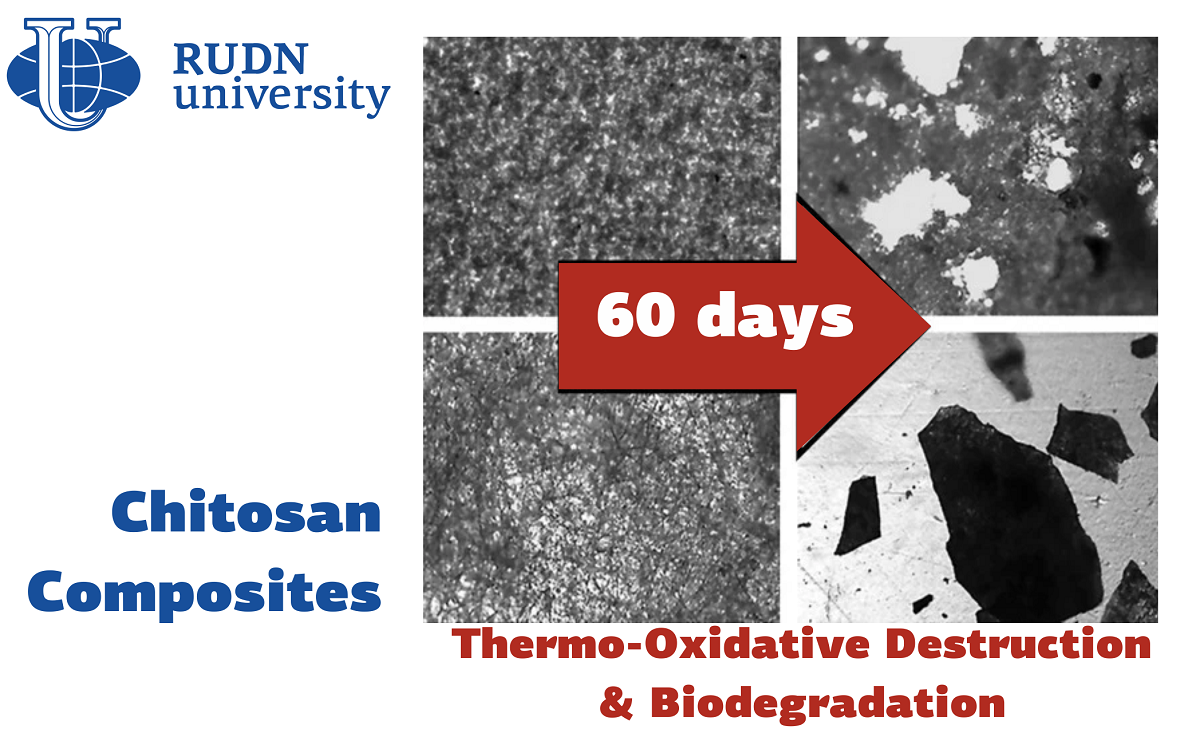
Biopolymers are used in biology, medicine, cell engineering, electronics to create, for example, healing films or to filter heavy metals and other pollutants. Biopolymer polyhydroxybutyrate in the form of microparticles is used for a drug delivery system with a prolonged effect — the carrier particle with the drug gradually decomposes and releases the drug into the desired area. The same material can be used to create degradable packaging. To control the rate of decomposition and otherproperties, fillers are added to biopolymers. For example, one of the most promising systems is the compound of polyhydroxybutyrate and chitosan (a substance that is part of the shells of animals and fungal cells). The properties of such compounds have already been studied for the case when chitosan is not enough in it, only 0.05-0.3%. The chemist of RUDN University investigated the properties of a complex compound with a significant content of chitosan — up to 70%.
“Now much attention in world science is paid to the creation of a new class of biodegradable materials from ultra-thin fibers. The most promising system is a mixture of polyhydroxybutyrate and chitosan. This combination has enabled the creation of a new generation of fully biodegradable systems with increased sorption capacity, controlled biodegradation rates and the ability to release substances with a wide range of speeds (from weeks to months). Therefore, we decided to study in detail the structure and peculiarity of the decomposition of materials based on polyhydroxybutyrate with a high (40-70%) chitosan content, ”- Candidate of Biological Sciences Alexander Vecher, Deputy Director of the Nanotechnology Center of RUDN University.
Chemists created films and fibers from polyhydrlksibutyrate and chitosan. The structure of the resulting material was studied using an electron scanning microscope, and its thermal properties were studied using a calorimeter. Chemists also investigated the decomposition of the film under the influence of soil microbes and oxygen.
Scientists are convinced that chitosan significantly changes the nanostructure of the biopolymer. Fibers of pure polyhydroxybutyrata are similar to thin tangled threads with thickenings, and inthefibers of the complex material look like distorted cylinders, from which thin processes are stretched along the axis. In soil,itosan slows down the process of decomposition of the material -for an application, about 40% of the fibers of pure polyhydriooxybutyrate and only 20% of the fibers of the complex polymerdecomposed in 30 days. Chemists explained this by the antimicrobial effect of chitosan. However, the addition of chitosan at the same time accelerates the decomposition of the material under the action of oxygen.
“Thus, the developed materials based on polyhydroxybutyrate and chitosan have an increased ability to oxidative decomposition, and also have potential antibacterial properties due to the presence of chitosan. These composite materials can be recommendedfor the creation ofdisposable biodegradable sorbents, medical materials and hygiene products, ”- Candidate of Biological Sciences Alexander Vecher, Deputy Director of the Nanotechnology Center of RUDN University.
The results are published in the journal Polymers.
Imagine a world where everyone has enough food, clean water, access to education, and decent work. A world where nature is protected and the future of our planet is cared for. These are the Sustainable Development Goals—to achieve a sustainable future for all! To this end, in 2015, the United Nations (UN) defined 17 Sustainable Development Goals (SDGs). The SDGs are a global plan that helps countries and people work together towards a better future. All 193 UN member states have joined the plan.
Researchers from the Faculty of Artificial Intelligence at RUDN University conducted a large-scale study that revealed systemic errors in large language models (LLMs) when diagnosing depression based on text. This work, carried out in collaboration with colleagues from AIRI, Federal Research Center “Computer Science and Control” of the Russian Academy of Sciences, Ivannikov Institute for System Programming of the Russian Academy of Sciences, Moscow Institute of Physics and Technology, and MBZUAI, not only identifies the problem but also lays the foundation for the creation of more reliable and secure tools for detecting depression and anxiety.
Alexandra Sentyabreva, a junior researcher at the Laboratory of Cell Technologies and Tissue Engineering at RUDN Research Institute of Molecular and Cellular Medicine at the Russian University of People's Friendship, won the competition for young scientists at the All-Russian Scientific Conference “Topical Issues of Morphogenesis in Norm and Pathology.” She was awarded the Academician A.P. Avtsyn Prize.
Imagine a world where everyone has enough food, clean water, access to education, and decent work. A world where nature is protected and the future of our planet is cared for. These are the Sustainable Development Goals—to achieve a sustainable future for all! To this end, in 2015, the United Nations (UN) defined 17 Sustainable Development Goals (SDGs). The SDGs are a global plan that helps countries and people work together towards a better future. All 193 UN member states have joined the plan.
Researchers from the Faculty of Artificial Intelligence at RUDN University conducted a large-scale study that revealed systemic errors in large language models (LLMs) when diagnosing depression based on text. This work, carried out in collaboration with colleagues from AIRI, Federal Research Center “Computer Science and Control” of the Russian Academy of Sciences, Ivannikov Institute for System Programming of the Russian Academy of Sciences, Moscow Institute of Physics and Technology, and MBZUAI, not only identifies the problem but also lays the foundation for the creation of more reliable and secure tools for detecting depression and anxiety.
Alexandra Sentyabreva, a junior researcher at the Laboratory of Cell Technologies and Tissue Engineering at RUDN Research Institute of Molecular and Cellular Medicine at the Russian University of People's Friendship, won the competition for young scientists at the All-Russian Scientific Conference “Topical Issues of Morphogenesis in Norm and Pathology.” She was awarded the Academician A.P. Avtsyn Prize.