




RUDN Engineers Show the Way to Control Satellite Formations More Effectively
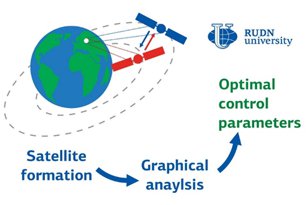
Some space missions use not one satellite, but several at once. It is necessary for example when it they need to observe one object on the surface of the Earth at different angles at the same time. In this case, satellites do not act independently, as for instance in navigation or telecommunication systems, but together — they constantly exchange information and adjust their relative movement. Such groups of satellites are called formations. They provide joint data on various objects on the Earth’s surface and in near-Earth space, but for this it is necessary to solve a complex optimization problem — to choose the optimal parameters for controlling the relative motion of satellites. A RUDN University engineers together with colleagues from Malaysia proposed how to simplify the calculation of the optimal control of the formation of satellites. It helps finding the optimal characteristic velocity that determines the required fuel consumption and increasing the efficiency of satellite formation control with minimal calculations.
“Our main goal is to simplify the on-board calculation of the optimal characteristic velocity, delta-v, and the corresponding orbital maneuver for controlling the formation of satellites. We have shown that the delta-v value can be found graphically instead of the traditional solution of complex dynamic equations,” said Yury Razoumny, Doctor of Technical Sciences, Director of the Department of Mechanics and Control Processes of RUDN University.
Scientists simulated a coordinated orbital maneuver of a formation of two satellites when observing a given ground object. At the same time, it is necessary to spend as little fuel as possible and provide the necessary monitoring conditions. The calculation of the optimal delta-v value is reduced to the analysis of possible options on the graphs of changes in the main parameters of the orbital motion of satellites in the formation. The best option is selected using a simple analysis of these graphs.
“This method is particularly well suited for observing objects on the earth’s surface. It allows, with low computational costs, to determine the lowest characteristic speed for the orbital maneuver of the formation satellites with the joint observation of the required object on the Earth’s surface,” said Yury Razoumny, Doctor of Technical Sciences, Director of the Department of Mechanics and Control Processes of RUDN University.
Results are published in Acta Astronautica.
Imagine a world where everyone has enough food, clean water, access to education, and decent work. A world where nature is protected and the future of our planet is cared for. These are the Sustainable Development Goals—to achieve a sustainable future for all! To this end, in 2015, the United Nations (UN) defined 17 Sustainable Development Goals (SDGs). The SDGs are a global plan that helps countries and people work together towards a better future. All 193 UN member states have joined the plan.
Researchers from the Faculty of Artificial Intelligence at RUDN University conducted a large-scale study that revealed systemic errors in large language models (LLMs) when diagnosing depression based on text. This work, carried out in collaboration with colleagues from AIRI, Federal Research Center “Computer Science and Control” of the Russian Academy of Sciences, Ivannikov Institute for System Programming of the Russian Academy of Sciences, Moscow Institute of Physics and Technology, and MBZUAI, not only identifies the problem but also lays the foundation for the creation of more reliable and secure tools for detecting depression and anxiety.
Alexandra Sentyabreva, a junior researcher at the Laboratory of Cell Technologies and Tissue Engineering at RUDN Research Institute of Molecular and Cellular Medicine at the Russian University of People's Friendship, won the competition for young scientists at the All-Russian Scientific Conference “Topical Issues of Morphogenesis in Norm and Pathology.” She was awarded the Academician A.P. Avtsyn Prize.
Imagine a world where everyone has enough food, clean water, access to education, and decent work. A world where nature is protected and the future of our planet is cared for. These are the Sustainable Development Goals—to achieve a sustainable future for all! To this end, in 2015, the United Nations (UN) defined 17 Sustainable Development Goals (SDGs). The SDGs are a global plan that helps countries and people work together towards a better future. All 193 UN member states have joined the plan.
Researchers from the Faculty of Artificial Intelligence at RUDN University conducted a large-scale study that revealed systemic errors in large language models (LLMs) when diagnosing depression based on text. This work, carried out in collaboration with colleagues from AIRI, Federal Research Center “Computer Science and Control” of the Russian Academy of Sciences, Ivannikov Institute for System Programming of the Russian Academy of Sciences, Moscow Institute of Physics and Technology, and MBZUAI, not only identifies the problem but also lays the foundation for the creation of more reliable and secure tools for detecting depression and anxiety.
Alexandra Sentyabreva, a junior researcher at the Laboratory of Cell Technologies and Tissue Engineering at RUDN Research Institute of Molecular and Cellular Medicine at the Russian University of People's Friendship, won the competition for young scientists at the All-Russian Scientific Conference “Topical Issues of Morphogenesis in Norm and Pathology.” She was awarded the Academician A.P. Avtsyn Prize.