




Surgery, science, lasers: a report by a RUDN University student won a competition at the conference “Clinical Laser Medicine in Russia: Advanced Technologies”
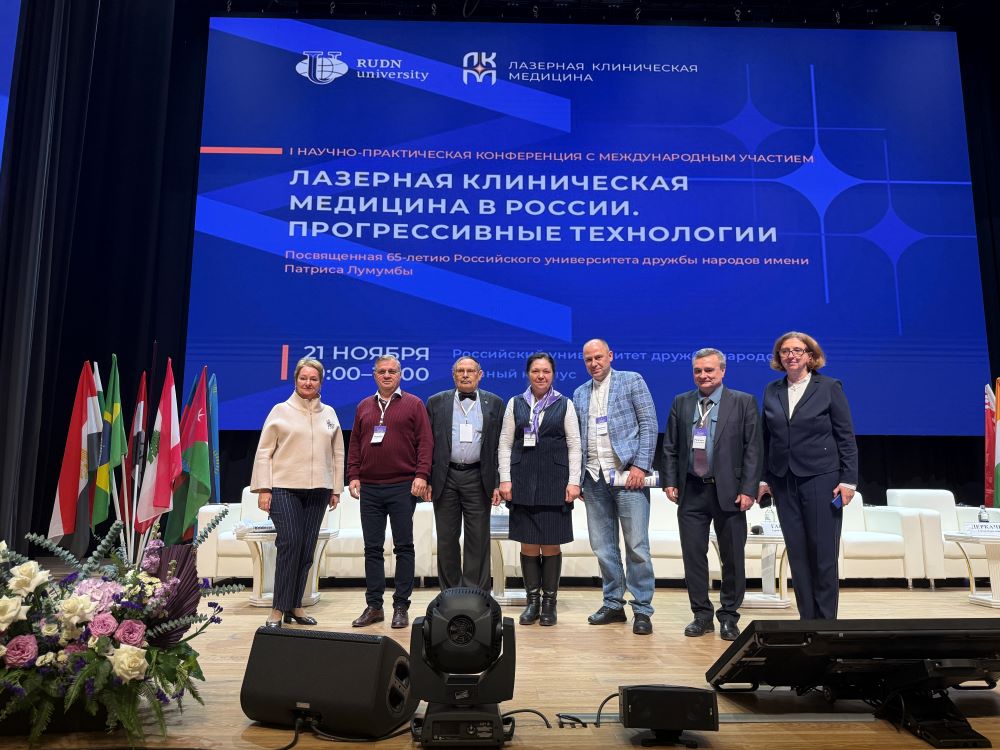
The main objectives of the event were:
- to broaden understanding of laser clinical medicine;
- to identify promising areas of research for the development of laser medical technologies in Russia;
- to share experience in the application of laser medical technologies in various fields of medicine;
- to bring together specialists who use laser technologies, manufacturers of laser equipment, and the younger generation of clinical medicine specialists.
The conference was opened by Alexey Abramov, Director of the RUDN University Medical Institute, and Oleg Yastrebov, Rector of the University, delivered a welcome video message to the participants. The event participants reviewed new progressive developments in the field of laser technologies for the diagnosis and treatment of inflammatory and oncological diseases, as well as injuries of various origins, including explosive lesions. The possibilities of their application in various fields of clinical medicine using high-intensity and low-intensity lasers of the latest generation were also discussed. In addition, scientists and doctors touched upon such topical issues of laser medicine as medical physics and laser technology, the effects of high-intensity and low-intensity laser radiation on biological tissues, as well as the use of laser medical technologies in surgery, dentistry, dermatology and other areas of medicine.
The conference was opened by Alexei Abramov, Director of the Medical Institute of RUDN University, and Oleg Yastrebov, Rector of RUDN University, delivered a welcome video address to the participants. The participants reviewed new advanced developments in the field of laser technologies for the diagnosis and treatment of inflammatory and oncological diseases, as well as injuries of various origins, including blast injuries. The possibilities of their application in various fields of clinical medicine using the latest generation of high-intensity and low-intensity lasers were also discussed. In addition, scientists and doctors touched upon such topical issues of laser medicine as medical physics and laser technology, the peculiarities of the effect of high-intensity and low-intensity laser radiation on biological tissues, as well as the application of laser medical technologies in surgery, dentistry, dermatology, and other areas of medicine.
Presentations were given by Valery Tuchin, Head of the Department of Optics and Biophotonics, Director of the Scientific Medical Center at Saratov State Medical University named after N.G. Chernyshevsky; Vladimir Zuev, laureate of the Russian Federation Government Award, professor at the Department of Obstetrics and Gynecology No. 1 at the N.V. Sklifosovsky Institute of Clinical Medicine at Sechenov University; Sergey Derkachev, Head of the Outpatient Surgery Department, Chief Phlebologist at the N.I. Pirogov Clinic of High Medical Technologies at St. Petersburg State University, and many others.
Lasers and wisdom tooth removal
The conference also featured a poster presentation competition among young scientists. The work of Oona Magera Basharovich (Syria), a postgraduate student at the Department of Propaedeutics of Dental Diseases at the Medical Institute of RUDN, took first place among medical universities. The topic of his research was “Clinical and radiological justification for the use of laser radiation in tooth extraction.” We interviewed the winner and learned about the essence of his presentation, the benefits of his research results, and his future plans for developing this work.
Why did you choose this theme?
The topic is related to the fact that tooth extraction remains a routine procedure in dental surgery practice. According to the literature, complications most often arise when removing wisdom teeth in the lower jaw due to abnormalities in their formation, position, and eruption. This issue is always relevant, as such an intervention is associated with high trauma and a long rehabilitation period due to severe pain and postoperative swelling. Today, lasers are used in all areas of medicine, as they are a unique tool in the hands of a surgeon, offering undeniable advantages: they allow for fine incisions and have antiseptic, bactericidal, hemostatic, analgesic, and other effects.
What is the essence of your research? How exactly does laser radiation help with tooth extraction, and what are its advantages over traditional methods?
We have used the properties of 940 nm wavelength diode laser radiation, both low-intensity and high-intensity, to remove impacted wisdom teeth in the lower jaw. High-intensity radiation was used for bactericidal treatment of the postoperative wound immediately after removal of the third molar, and low-intensity radiation was used on the third day to relieve pain in the postoperative area using a special attachment. We used this attachment to treat postoperative swelling in the area of tooth extraction on the skin of the lower jaw. The advantage of using a laser is less pronounced postoperative swelling. And if the swelling is less, the pain is also significantly weaker, so no painkillers were required. Wound epithelialization and healing proceeded more quickly, as laser radiation stimulates regeneration. In addition, the risk of complications and recurrence is reduced. All this allows patients to recover faster and return to work.
What are the future plans for developing this research?
Laser technologies make it possible to improve surgical techniques, increase the effectiveness of treatment, and reduce the risk of local complications such as alveolitis and osteomyelitis. The laser we used is a diode laser, and all diode lasers only work on soft tissues. In the future, we plan to use an erbium laser, as it is the only laser that works with hard tissues (teeth, bone), and this is promising. Currently, the department is working on tooth extraction in patients with complex somatic pathologies; I am observing these patients, and they are having very good results.
The first research and practical conference ‘Functional Morphology of the Tissue Microenvironment: From Theory to Practice’, dedicated to the memory of Academician Mikhail Paltsev of the Russian Academy of Sciences, was held at RUDN. It brought together leading researchers from Russia, China and other countries.
The Skolkovo Foundation (VEB.RF), together with the Ministry of Natural Resources and Environment of the Russian Federation and the country’s leading industrial companies, announced the launch of the sixth cycle of Russia’s largest supplier ecosystem development program for industry, GreenTech Sustainable Development. Applications from developers of technological solutions will be accepted until October 20, 2025.
On September 24 RUDN University hеld the International Scientific Conference “Russia and Africa: Heritage of the Past, Opportunities of the Present, Prospects for the Future”, in Honor of the 100th Anniversary of Patrice Lumumba.
The first research and practical conference ‘Functional Morphology of the Tissue Microenvironment: From Theory to Practice’, dedicated to the memory of Academician Mikhail Paltsev of the Russian Academy of Sciences, was held at RUDN. It brought together leading researchers from Russia, China and other countries.
The Skolkovo Foundation (VEB.RF), together with the Ministry of Natural Resources and Environment of the Russian Federation and the country’s leading industrial companies, announced the launch of the sixth cycle of Russia’s largest supplier ecosystem development program for industry, GreenTech Sustainable Development. Applications from developers of technological solutions will be accepted until October 20, 2025.
On September 24 RUDN University hеld the International Scientific Conference “Russia and Africa: Heritage of the Past, Opportunities of the Present, Prospects for the Future”, in Honor of the 100th Anniversary of Patrice Lumumba.