




New Method Allows Detecting Tumor by Measuring its Temperature
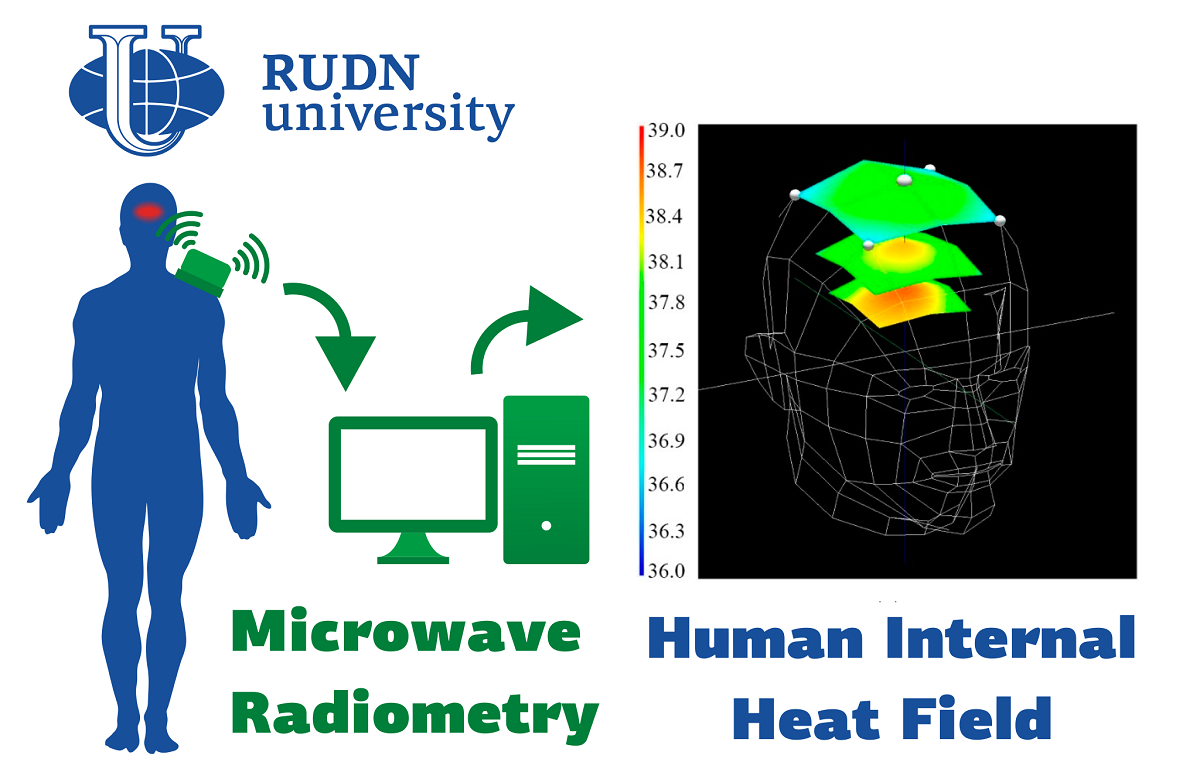
Cancers, blood flow disorders, arthritis, and other diseases alter body temperature, so one way to diagnose such diseases is to detect a temperature change. It is easy to do on the surface of the skin, for example with an infrared pyrometer. But it is impossible to accurately measure the temperature inside the body without damaging the skin with existing tools. A group of researchers with the participation of an RUDN University scientist proposed a radiothermography method that allows measuring the temperature distribution inside the body.
“The purpose of this study is to show the possibility of 3D visualization of the internal thermal field of a person using the results of measurements of radio brightness temperatures, simultaneously measured at different points of the body, using a multi-channel multi-frequency radiothermograph. The novelty of the approach considered is an attempt to more accurately localize the heat source position due to 3D visualization of the internal heat field of a body and monitoring the temperature dynamics of a heat point source inside the human body,” said Svetlana Agasieva, Associate Professor of the Department of Nanotechnology and Microsystem Technology at the Academy of Engineering of RUDN University.
Researchers have proposed a method, device and software to accurately determine the location of the source of increased heat in the body. A small antenna is installed on the surface of the body, which can measure the internal temperature with an accuracy of one degree. The patient drinks an aqueous glucose solution, it is quickly absorbed into the blood and carried through the cells. Because of this, the body temperature rises evenly by one to two tenths of a degree. However, if there is a malignant formation somewhere, the temperature in it will rise sharply by one or two degrees for a few minutes. This change can be detected by the device. To clarify the depth of the pathology location, the researchers developed a calculation method.
The device and the simulation results were tested experimentally with real patients. The method visualises temperature “layers” on the screen of a computer. One can scroll through them with the mouse to accurately determine the depth of the heat source. Moreover, you can see on the video how the temperature changed in this area. In the future, the researchers will realize clinical trials of the device.
“The detailed information about the internal thermal field of a human body has made possible not only detection of an internal malignant tumor, but also determination of the depth of its location. The new radiothermograph gives an opportunity for more detailed analysis of the state of the vascular system of the brain and early diagnosis of various brain pathologies. Of course, it is too early to talk about all the possibilities and advantages of the new radiothermograph, which will be confirmed during clinical tests that will begin in the nearest future,” Svetlana Agasieva, Associate Professor of the Department of Nanotechnology and Microsystem Technology at the Academy of Engineering of RUDN University.
Results were published in Sensors.
Imagine a world where everyone has enough food, clean water, access to education, and decent work. A world where nature is protected and the future of our planet is cared for. These are the Sustainable Development Goals—to achieve a sustainable future for all! To this end, in 2015, the United Nations (UN) defined 17 Sustainable Development Goals (SDGs). The SDGs are a global plan that helps countries and people work together towards a better future. All 193 UN member states have joined the plan.
Researchers from the Faculty of Artificial Intelligence at RUDN University conducted a large-scale study that revealed systemic errors in large language models (LLMs) when diagnosing depression based on text. This work, carried out in collaboration with colleagues from AIRI, Federal Research Center “Computer Science and Control” of the Russian Academy of Sciences, Ivannikov Institute for System Programming of the Russian Academy of Sciences, Moscow Institute of Physics and Technology, and MBZUAI, not only identifies the problem but also lays the foundation for the creation of more reliable and secure tools for detecting depression and anxiety.
Alexandra Sentyabreva, a junior researcher at the Laboratory of Cell Technologies and Tissue Engineering at RUDN Research Institute of Molecular and Cellular Medicine at the Russian University of People's Friendship, won the competition for young scientists at the All-Russian Scientific Conference “Topical Issues of Morphogenesis in Norm and Pathology.” She was awarded the Academician A.P. Avtsyn Prize.
Imagine a world where everyone has enough food, clean water, access to education, and decent work. A world where nature is protected and the future of our planet is cared for. These are the Sustainable Development Goals—to achieve a sustainable future for all! To this end, in 2015, the United Nations (UN) defined 17 Sustainable Development Goals (SDGs). The SDGs are a global plan that helps countries and people work together towards a better future. All 193 UN member states have joined the plan.
Researchers from the Faculty of Artificial Intelligence at RUDN University conducted a large-scale study that revealed systemic errors in large language models (LLMs) when diagnosing depression based on text. This work, carried out in collaboration with colleagues from AIRI, Federal Research Center “Computer Science and Control” of the Russian Academy of Sciences, Ivannikov Institute for System Programming of the Russian Academy of Sciences, Moscow Institute of Physics and Technology, and MBZUAI, not only identifies the problem but also lays the foundation for the creation of more reliable and secure tools for detecting depression and anxiety.
Alexandra Sentyabreva, a junior researcher at the Laboratory of Cell Technologies and Tissue Engineering at RUDN Research Institute of Molecular and Cellular Medicine at the Russian University of People's Friendship, won the competition for young scientists at the All-Russian Scientific Conference “Topical Issues of Morphogenesis in Norm and Pathology.” She was awarded the Academician A.P. Avtsyn Prize.