




RUDN Chemists Have Created a Reusable Switch Catalyst for The Synthesis of Two Different Compounds
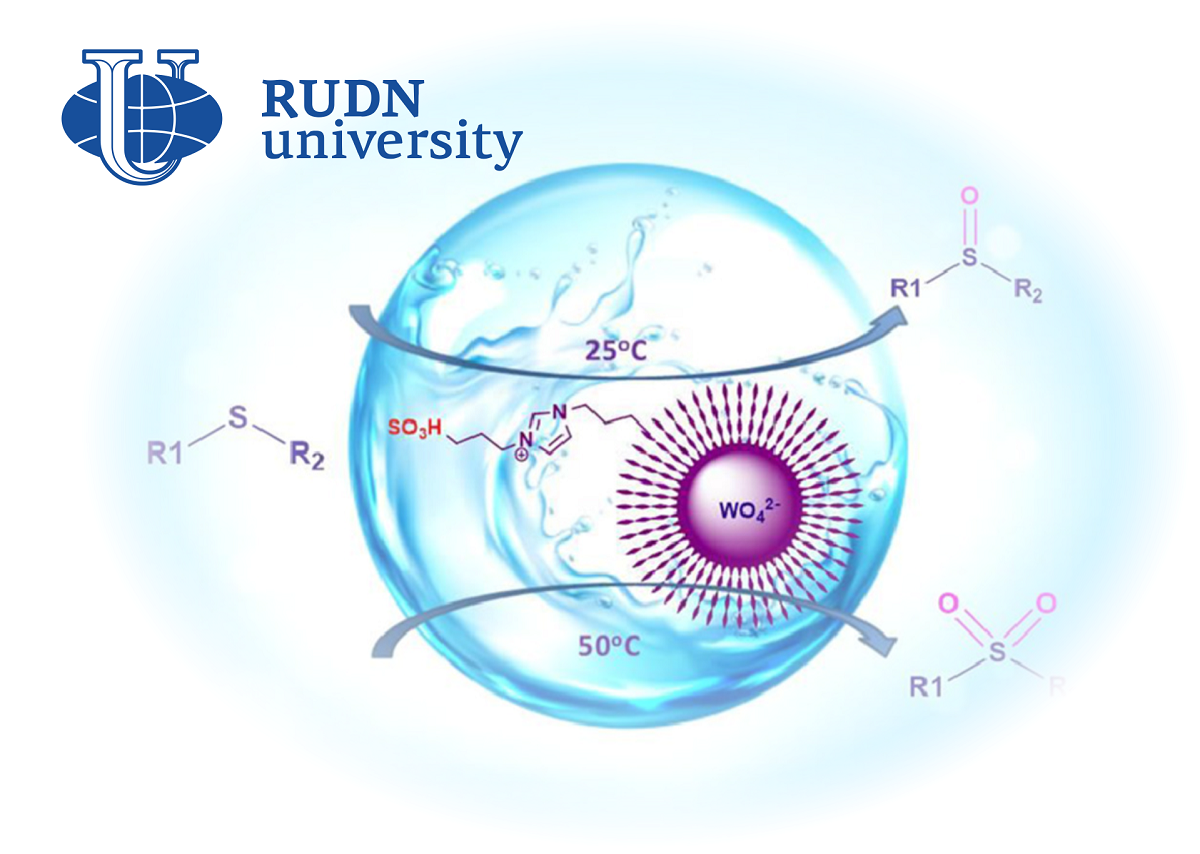
Sulfur analogues of esters are called sulfides. When they are oxidized, one or two oxygen atoms will join the sulfur atom. It turns out sulfoxides or sulfones. Sulfones are used, for example, as dyes for fabrics and paper, and a number of sulfoxides are part of anti-ulcer drugs. One of the main problems in the oxidation of sulfides is to attach the right amount of oxygen atoms to sulfur, that is, for example, not to peroxify the sulfide with two atoms instead of one and not to get sulfone instead of sulfoxide. RUDN chemists have created a universal catalyst — it is suitable for the synthesis of both sulfones and sulfoxides and “switches” from one mode to another when the temperature changes. In addition, it allows the reaction to be carried out in environmentally friendly conditions, and it can be reused.
“One of the main problems with selective oxidation of sulfides to sulfoxides is excessive oxidation to sulfones. Strong oxidizers easily oxidize sulfides to sulfones, but this can also happen with milder reagents. We have shown the possibility of using a switchable catalyst for the oxidation of sulfides to sulfoxides or sulfones depending on the reaction temperature. The analysis of the reaction conditions showed that the catalyst works best in an aqueous environment, which, together with the use of oxygen as an oxidizer and the possibility of reuse, creates one of the most environmentally friendly conditions for such oxidation,” Professor Leonid Voskresensky, Dean of the Faculty of Physics, Mathematics and Natural Sciences of the RUDN.
Chemists have proposed a catalyst that consists of a nanomaterial based on a porous organosilicon framework and an ionic liquid of tungsten oxide. To prove its catalytic effect, the RUDN chemists added it to a solution of one of the sulfides and stirred the mixture at a temperature of 25℃ or 50℃ and with oxygen supply. After the reaction, the nanocatalyst was filtered and washed in ethyl acetate. Chemists optimized the reaction by “picking up” the solvent, reaction time and amount of catalyst, which give the maximum yield of the final product.
The reaction was most effective under the “simplest” conditions — 10 mg of catalyst, an aqueous solution, two hours of reaction. Under such conditions, 98% of the product yield was achieved. At room temperature, sulfoxides were obtained (yield 92%-99% depending on the initial sulfide), at an increase in temperature to 50℃ — sulfones (90%-97%). After eight cycles of use and washing, the efficiency of the catalyst practically did not decrease.
“We have proven the effectiveness of this reusable nanocatalyst for selective aerobic oxidation of sulfides to sulfoxides or sulfones depending on temperature. In addition, the catalyst, which is easily separated from the reaction mixture, can be reused without significantly reducing its performance. The simplicity of the preparation of the catalyst and its wide range of applications for both sulfoxides and sulfones under mild conditions make it suitable for practical use,” — Rafael Luque, professor at the Center for Molecular Design and Synthesis of Innovative Compounds for Medicine of the RUDN.
The study is published in Molecular Catalysis.
Imagine a world where everyone has enough food, clean water, access to education, and decent work. A world where nature is protected and the future of our planet is cared for. These are the Sustainable Development Goals—to achieve a sustainable future for all! To this end, in 2015, the United Nations (UN) defined 17 Sustainable Development Goals (SDGs). The SDGs are a global plan that helps countries and people work together towards a better future. All 193 UN member states have joined the plan.
Researchers from the Faculty of Artificial Intelligence at RUDN University conducted a large-scale study that revealed systemic errors in large language models (LLMs) when diagnosing depression based on text. This work, carried out in collaboration with colleagues from AIRI, Federal Research Center “Computer Science and Control” of the Russian Academy of Sciences, Ivannikov Institute for System Programming of the Russian Academy of Sciences, Moscow Institute of Physics and Technology, and MBZUAI, not only identifies the problem but also lays the foundation for the creation of more reliable and secure tools for detecting depression and anxiety.
Alexandra Sentyabreva, a junior researcher at the Laboratory of Cell Technologies and Tissue Engineering at RUDN Research Institute of Molecular and Cellular Medicine at the Russian University of People's Friendship, won the competition for young scientists at the All-Russian Scientific Conference “Topical Issues of Morphogenesis in Norm and Pathology.” She was awarded the Academician A.P. Avtsyn Prize.
Imagine a world where everyone has enough food, clean water, access to education, and decent work. A world where nature is protected and the future of our planet is cared for. These are the Sustainable Development Goals—to achieve a sustainable future for all! To this end, in 2015, the United Nations (UN) defined 17 Sustainable Development Goals (SDGs). The SDGs are a global plan that helps countries and people work together towards a better future. All 193 UN member states have joined the plan.
Researchers from the Faculty of Artificial Intelligence at RUDN University conducted a large-scale study that revealed systemic errors in large language models (LLMs) when diagnosing depression based on text. This work, carried out in collaboration with colleagues from AIRI, Federal Research Center “Computer Science and Control” of the Russian Academy of Sciences, Ivannikov Institute for System Programming of the Russian Academy of Sciences, Moscow Institute of Physics and Technology, and MBZUAI, not only identifies the problem but also lays the foundation for the creation of more reliable and secure tools for detecting depression and anxiety.
Alexandra Sentyabreva, a junior researcher at the Laboratory of Cell Technologies and Tissue Engineering at RUDN Research Institute of Molecular and Cellular Medicine at the Russian University of People's Friendship, won the competition for young scientists at the All-Russian Scientific Conference “Topical Issues of Morphogenesis in Norm and Pathology.” She was awarded the Academician A.P. Avtsyn Prize.