




Biochemist discovers a promising enzyme to fight cancer cells
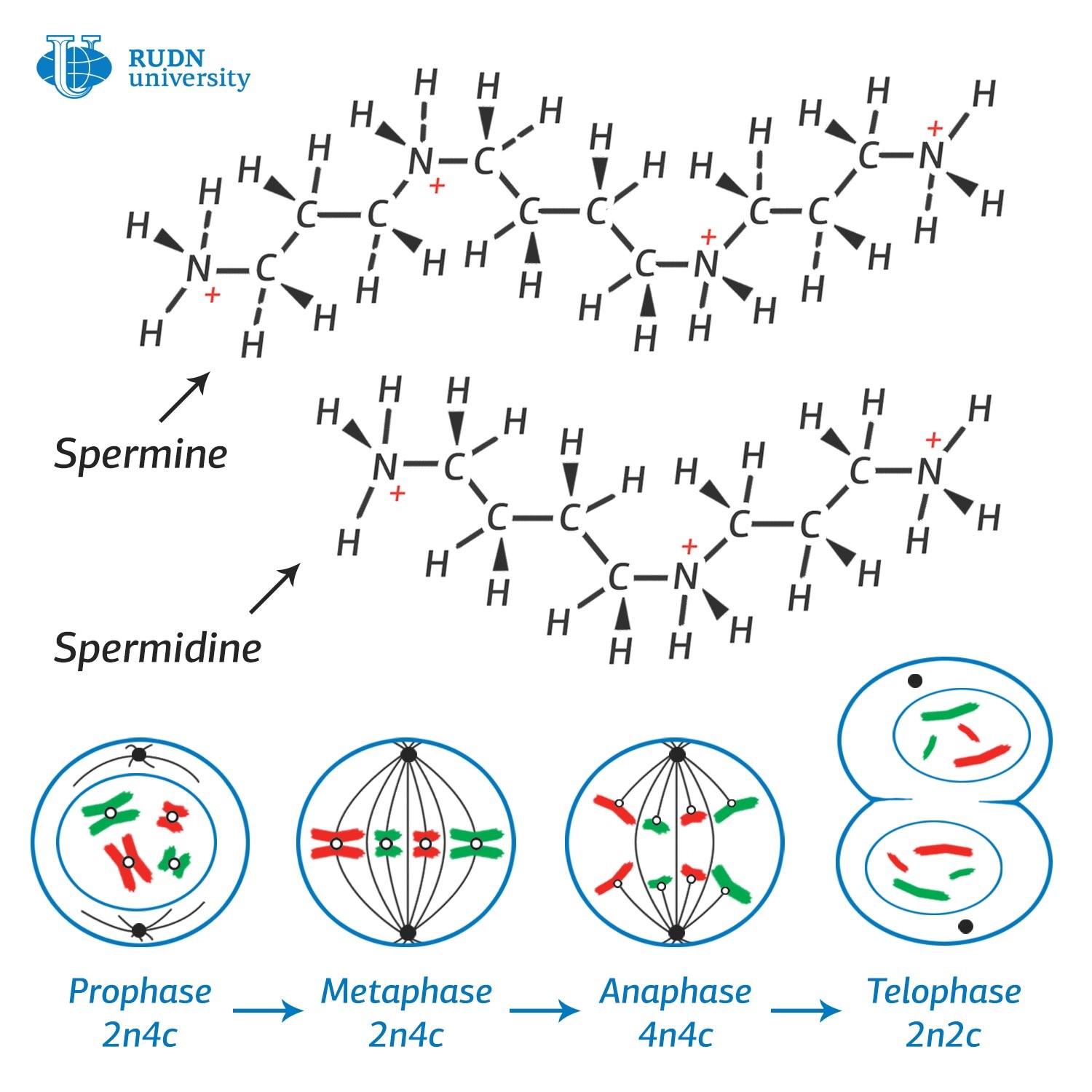
Polyamines (PA)—spermidine (Spd) and spermine (Spm)—play an important role in the body’s protective reactions. Polyamines are regulators of growth, differentiation and the process of cell death. The dynamics of the metabolism of polyamines is used in the diagnosis of pathologies of systems and organs. Disorders in the metabolism of polyamines lead to an increase in their concentration in the body. This is accompanied by accelerated tissue proliferation due to cell division. This mechanism is typical of various forms of cancer. On the other hand, some decay products by oxidation of polyamines show antitumor and antimicrobial activity and slow the growth of certain types of cancer cells, bacteria and viruses. A RUDN University biochemist proposed to use these properties for the treatment of cancer.
Professor of the Department of Biochemistry of RUDN University Sergey Syatkin designed the structure of the molecule (ligand) with predetermined properties. To do this, he used bioinformatics and computer modeling technologies, primarily molecular docking. This method allowed him to predict how the drug molecules will behave in relation to the target protein. Based on molecular docking data, biochemists synthesized 36 nitrogen-containing substances with different chemical structures. They made a classification of the stimulating effects of these substances on the cells of the body. It turned out that the effects of a potential drug depended on the way in which the special molecules—ligands—included in their composition, accelerated the decay of polyamines by their oxidation.
Using computer simulations, biochemists visually detected how the molecules of inorganic substances that make up the potential drug will dock with one of the mouse proteins. Their classification made it possible to correctly predict the nature of the effects that the substance of the drug will have on the body of an experimental animal. After that, a series of experiments on rats was carried out.
Experiments have shown that substances that can enhance the oxidation of PA can become potential anti-cancer agents. This opens up the prospect of developing antitumor drugs based on the use of substances that activate the rate of decay of PA by enzymatic oxidation.
Imagine a world where everyone has enough food, clean water, access to education, and decent work. A world where nature is protected and the future of our planet is cared for. These are the Sustainable Development Goals—to achieve a sustainable future for all! To this end, in 2015, the United Nations (UN) defined 17 Sustainable Development Goals (SDGs). The SDGs are a global plan that helps countries and people work together towards a better future. All 193 UN member states have joined the plan.
Researchers from the Faculty of Artificial Intelligence at RUDN University conducted a large-scale study that revealed systemic errors in large language models (LLMs) when diagnosing depression based on text. This work, carried out in collaboration with colleagues from AIRI, Federal Research Center “Computer Science and Control” of the Russian Academy of Sciences, Ivannikov Institute for System Programming of the Russian Academy of Sciences, Moscow Institute of Physics and Technology, and MBZUAI, not only identifies the problem but also lays the foundation for the creation of more reliable and secure tools for detecting depression and anxiety.
Alexandra Sentyabreva, a junior researcher at the Laboratory of Cell Technologies and Tissue Engineering at RUDN Research Institute of Molecular and Cellular Medicine at the Russian University of People's Friendship, won the competition for young scientists at the All-Russian Scientific Conference “Topical Issues of Morphogenesis in Norm and Pathology.” She was awarded the Academician A.P. Avtsyn Prize.
Imagine a world where everyone has enough food, clean water, access to education, and decent work. A world where nature is protected and the future of our planet is cared for. These are the Sustainable Development Goals—to achieve a sustainable future for all! To this end, in 2015, the United Nations (UN) defined 17 Sustainable Development Goals (SDGs). The SDGs are a global plan that helps countries and people work together towards a better future. All 193 UN member states have joined the plan.
Researchers from the Faculty of Artificial Intelligence at RUDN University conducted a large-scale study that revealed systemic errors in large language models (LLMs) when diagnosing depression based on text. This work, carried out in collaboration with colleagues from AIRI, Federal Research Center “Computer Science and Control” of the Russian Academy of Sciences, Ivannikov Institute for System Programming of the Russian Academy of Sciences, Moscow Institute of Physics and Technology, and MBZUAI, not only identifies the problem but also lays the foundation for the creation of more reliable and secure tools for detecting depression and anxiety.
Alexandra Sentyabreva, a junior researcher at the Laboratory of Cell Technologies and Tissue Engineering at RUDN Research Institute of Molecular and Cellular Medicine at the Russian University of People's Friendship, won the competition for young scientists at the All-Russian Scientific Conference “Topical Issues of Morphogenesis in Norm and Pathology.” She was awarded the Academician A.P. Avtsyn Prize.