




RUDN University chemists developed cheap and eco-friendly surfactants
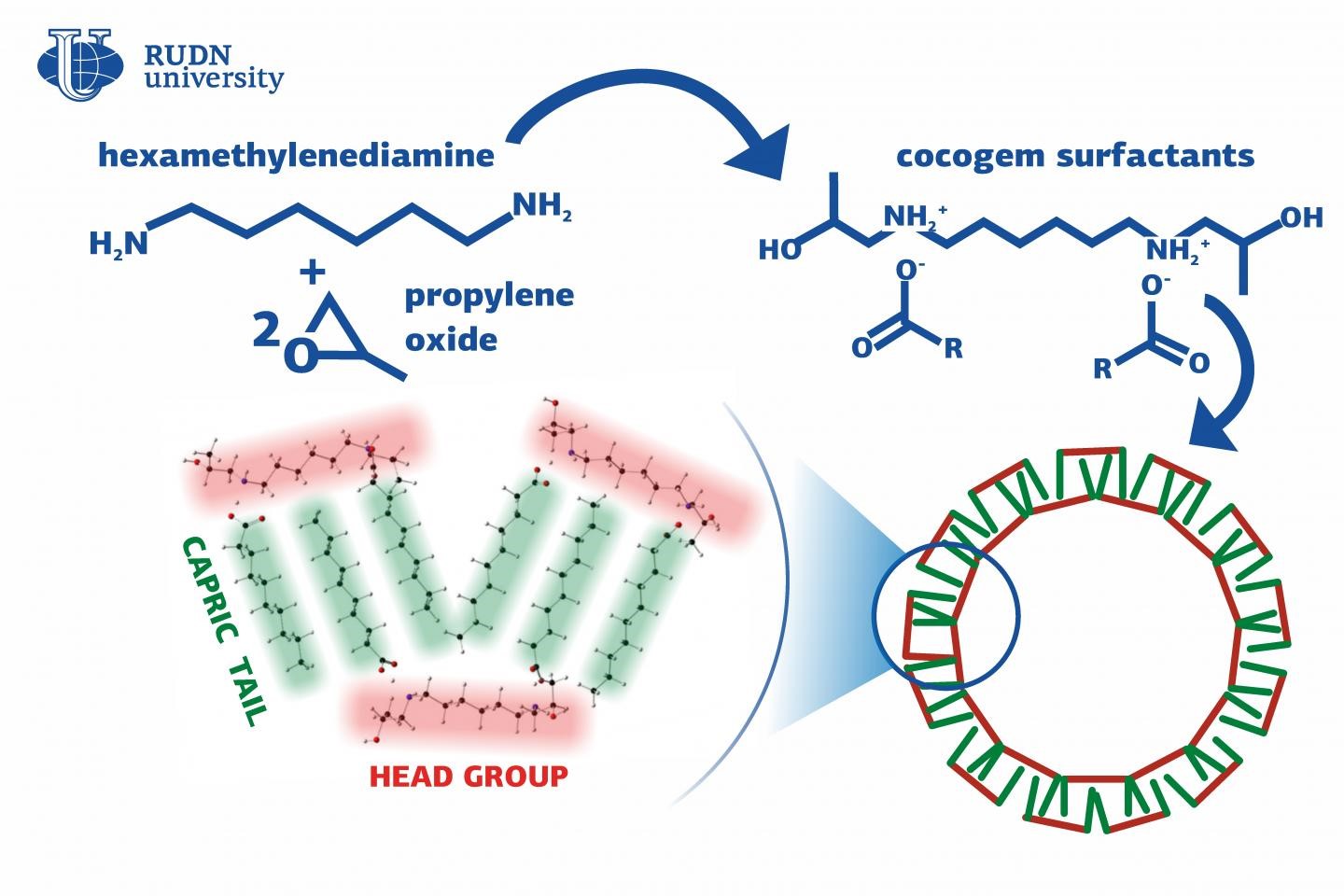
Surfactants are common both in the industry and in our everyday life. They are used as bases for detergents, added to lubricants and construction materials (concrete mixes, cement, and drilling fluids), and protect equipment from corrosion. The most effective of them are gemini surfactants that contain two hydrophilic (water-attracting) groups. However, there also “pseudo” gemini surfactants that have one hydrophilic and one hydrophobic (water-resistant) group of atoms bound together. An international team of chemists including partners from RUDN University synthesized several new “pseudo” gemini surfactants and confirmed that their performance characteristics were on par with the existing compounds. The new synthesis method is quite cost-efficient, works at room temperature, and does not require expensive reagents.
“The creation of cheap methods for the synthesis of gemini surfactants with satisfactory performance characteristics can be a turning point for the chemistry of detergents. We focused both on the development of synthetic methods and on studying the properties of new compounds,” said Fedor Zubkov, a PhD, and an Assistant Professor at the Department of Organic Chemistry, RUDN University.
To create new compounds, the chemists used six common higher fatty acids: capric, lauric, myristic, palmitic, stearic, and oleic acid. The hydrophilic properties of the new surfactants came from amines synthesized based on two affordable reagents—hexamethylenediamine and epoxypropene. To obtain a surfactant, the team dissolved an amine and one one the acids (at the ratio 1:2) in acetone at room temperature and then concentrated the solvent. The final products looked like viscous yellow liquids. The molecules of the surfactants were formed due to electrostatic interaction between oxygen atoms in the carboxylic groups of the acids and amino groups in the amine.
The team at RUDN University conducted a thorough study of the properties of the new compounds and paid special attention to the key characteristic of surfactants—their ability to reduce the superficial tension of solutions and form micelles. It is this property that makes surfactants usable in the skincare industry. The lowest superficial tension values (up to 20 mN/m) were registered for the surfactant based on myristic acid. By this parameter, the new surfactant is almost identical to fluorine-containing ones that are often used in the industry. However, unlike them, the new compound is more environmentally friendly. Weaker chemical bonds make it biodegradable and therefore unlikely to be accumulated in the environment.
Other important characteristics of surfactants are foam formation and foam stability. Five out of six new surfactants formed foam in a water solution, and in the case of two of them (based on lauric and myristic acids), the volume of produced foam exceded the volume of the initial solution 3 to 4 times. The compounds based on palmitic and stearic acids produced less foam, but it was more stable and lasted up to three days. These and other characteristics of the new compounds make them promising for the skincare industry, medicine, anti-corrosion treatment of construction and industrial facilities, and oil recovery increase.
“Gemini surfactants and their synthesis are a burning issue for modern chemistry, as they can potentially replace traditional monomeric surfactants and make the chemical industry move environmentally friendly,” added Fedor Zubkov.
The article was published in Journal of Molecular Liquids.
Imagine a world where everyone has enough food, clean water, access to education, and decent work. A world where nature is protected and the future of our planet is cared for. These are the Sustainable Development Goals—to achieve a sustainable future for all! To this end, in 2015, the United Nations (UN) defined 17 Sustainable Development Goals (SDGs). The SDGs are a global plan that helps countries and people work together towards a better future. All 193 UN member states have joined the plan.
Researchers from the Faculty of Artificial Intelligence at RUDN University conducted a large-scale study that revealed systemic errors in large language models (LLMs) when diagnosing depression based on text. This work, carried out in collaboration with colleagues from AIRI, Federal Research Center “Computer Science and Control” of the Russian Academy of Sciences, Ivannikov Institute for System Programming of the Russian Academy of Sciences, Moscow Institute of Physics and Technology, and MBZUAI, not only identifies the problem but also lays the foundation for the creation of more reliable and secure tools for detecting depression and anxiety.
Alexandra Sentyabreva, a junior researcher at the Laboratory of Cell Technologies and Tissue Engineering at RUDN Research Institute of Molecular and Cellular Medicine at the Russian University of People's Friendship, won the competition for young scientists at the All-Russian Scientific Conference “Topical Issues of Morphogenesis in Norm and Pathology.” She was awarded the Academician A.P. Avtsyn Prize.
Imagine a world where everyone has enough food, clean water, access to education, and decent work. A world where nature is protected and the future of our planet is cared for. These are the Sustainable Development Goals—to achieve a sustainable future for all! To this end, in 2015, the United Nations (UN) defined 17 Sustainable Development Goals (SDGs). The SDGs are a global plan that helps countries and people work together towards a better future. All 193 UN member states have joined the plan.
Researchers from the Faculty of Artificial Intelligence at RUDN University conducted a large-scale study that revealed systemic errors in large language models (LLMs) when diagnosing depression based on text. This work, carried out in collaboration with colleagues from AIRI, Federal Research Center “Computer Science and Control” of the Russian Academy of Sciences, Ivannikov Institute for System Programming of the Russian Academy of Sciences, Moscow Institute of Physics and Technology, and MBZUAI, not only identifies the problem but also lays the foundation for the creation of more reliable and secure tools for detecting depression and anxiety.
Alexandra Sentyabreva, a junior researcher at the Laboratory of Cell Technologies and Tissue Engineering at RUDN Research Institute of Molecular and Cellular Medicine at the Russian University of People's Friendship, won the competition for young scientists at the All-Russian Scientific Conference “Topical Issues of Morphogenesis in Norm and Pathology.” She was awarded the Academician A.P. Avtsyn Prize.